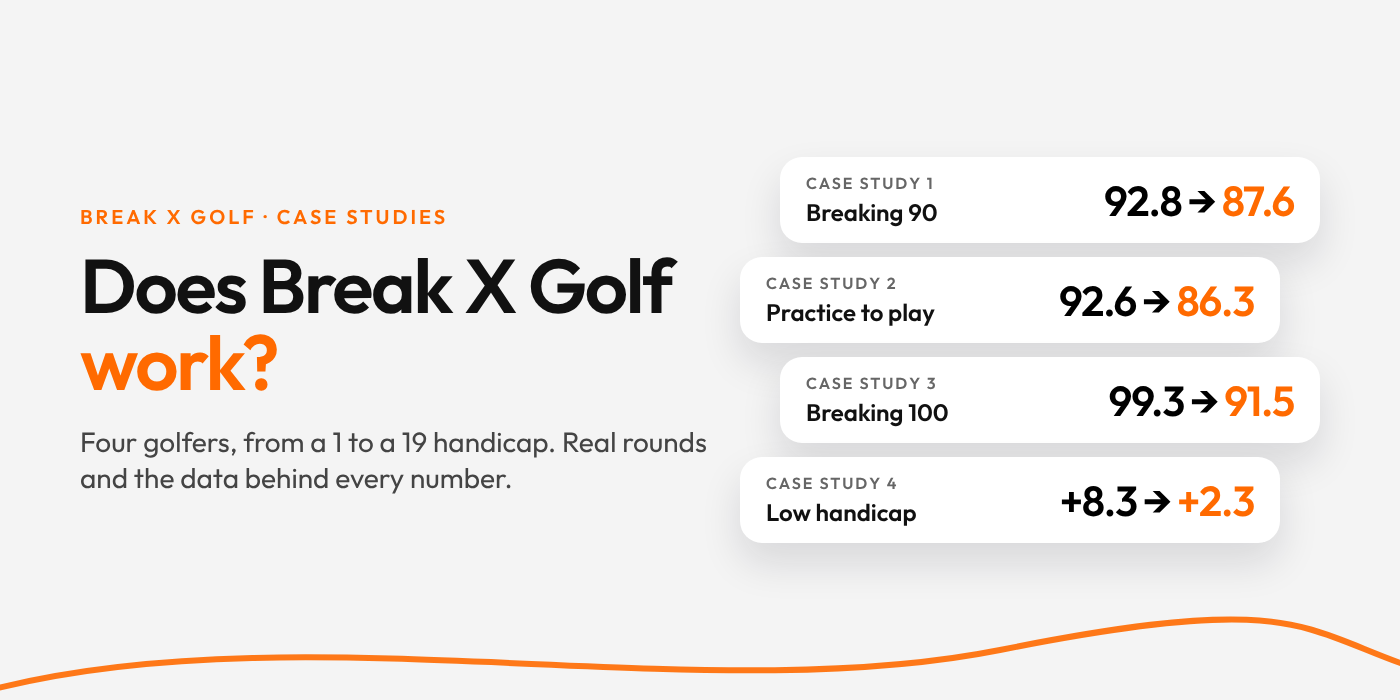
Short answer: for golfers who enter their rounds and do the practice, yes. The four golfers below, from a 1 handicap to a 19 handicap, cut their average score by 5 to 8 shots between their earliest and latest rounds, using our new app released in May 2026. Each case study shows every round, where the shots came from and gives you a breakdown of what changed in the golfers’ performance.
Last updated: 22 October 2026. Results vary.
Results at a glance
Average score, early rounds vs latest rounds
Case study 1: Breaking 90
Case study 2: Practice to play
Case study 3: Breaking 100
Case study 4: Low handicap
Break X Golf golfers using our new app (released May 2026, with beta testers from earlier in the year). 18-hole rounds only. Case studies 1–3 are anonymised; case study 4 is co-founder Will Shaw. Results vary.
Four golfers, four results
These are the first case studies from our new app, released in May 2026. We’re not here to sell magic fixes; just honest stories of golfers getting better. Lowering your scores takes time, and golfers need to play several rounds for us to track progress. We’ll add more case studies as golfers progress. Break X Golf provides a clearer path to lower scores and makes practice more focused and more fun.
Each one compares a golfer’s early rounds with their latest rounds. Case studies 1 to 3 are anonymised. Case study 4 is me (I have limited time to practice, but yes, I use our app too).
Case study 1: Breaking 90
A 15 handicapper shooting in the low 90s. Two of their first 10 rounds were under 90. Six of their last 10 were. That’s really solid progress over the summer, with a 5-shot drop in average scores.
Case study 1
Breaking 90: from 93 to 87
15 handicap · 18-hole rounds · 2026
Average score
Average score, first 10 rounds vs last 10 rounds
First 10 rounds
Last 10 rounds
Under 90
What changed: fewer disasters, not more birdies.
Most of the gain came from approach shots, mainly from 125–150 yards (+1.2 shots a round) and 50–100 yards (+0.8).
Anonymised Break X Golf golfer · first 10 vs last 10 rounds · strokes gained vs a tour baseline · results vary
They didn’t start making more birdies. They stopped making doubles. Doubles or worse almost halved, from 5.9 to 3.0 a round, and most of the shots came back on approach shots from 125–150 and 50–100 yards.
Case study 2: Practice to play
A competition golfer who logged 8 rounds between July and October. Their worst round of the season, a 98, came in early September.
Case study 2
Practice to play: what changed after a 98
Competition golfer · 8 competition rounds · Jul–Oct 2026
Average score
Average score, first 5 rounds vs last 3 rounds
First 5 rounds
Last 3 rounds
Worst round of the season
What changed: after their worst round of the season, they practiced more and gave more of it to the short game.
Their next three rounds were 86, 88 and 85, their best of the season. Approach play improved too (+2.7 shots a round).
Anonymised Break X Golf golfer · first 5 vs last 3 competition rounds · scores lower on both courses they play · results vary
In the 7 days after that 98, they did 12 practice sessions, their biggest week by far, and nearly half their practice balls went into the short game. Their next three rounds were 86, 88 and 85, and their scores came down on both courses they play.
This is exactly how the app works:
- Enter data
- Find weaknesses
- Target them with practice
- Watch those areas improve
Case study 3: Breaking 100
A 19 handicapper who started in our beta in April. Only one of their first four full rounds was under 100.
Case study 3
Breaking 100: from 99 to 92
19 handicap · 8 rounds · Apr–Jul 2026
Average score
Average score, first 4 rounds vs last 4 rounds
First 4 rounds
Last 4 rounds
Under 100
What changed: far fewer big numbers.
Doubles or worse dropped by 3.5 a round, and they hit almost twice as many greens. Approach and short game each gained about 2 shots a round.
Anonymised Break X Golf golfer · first 4 vs last 4 eighteen-hole rounds · strokes gained vs a tour baseline · results vary
All four of their latest rounds were under 100. Fewer big numbers made the difference: doubles or worse dropped from 9.0 to 5.5 a round, and they hit almost twice as many greens.
Case study 4: A 1 handicapper finding form again
This final case study is me. After some swing changes, I had a rough August: +7, +11, +9 and +6. It felt like I was missing drives both ways. The data said otherwise: most of my missed fairways went left, and the left misses were costing more than twice as many shots.
Case study 4 · Low handicap
A 1 handicapper finding form again
Will Shaw, Break X Golf co-founder · 11 rounds · Aug–Oct 2026, after swing changes
Average score to par
First 4 rounds in August vs last 3 rounds (every round shown)
August: first 4 rounds
Late August to mid September
Last 3 rounds
What the data found: driving
It felt like drives were going both ways. Since August, 61% of missed fairways went left, and left misses cost 2.4 times as many shots (2.9 vs 1.2 a round).
What the data found: short putts
Inside 5 feet, 71% of putts that missed went left, including all 5 in the two most recent rounds with full putt detail. From 5–10 feet, misses split evenly.
What changed: knowing the miss was left, not both ways, gave the swing work and the driving practice one clear target.
Driving went from costing 4.6 shots a round to 1.1, and the last three rounds were +5, +2 and level par. Putting hasn’t improved yet, I can see my practice scores improving, and this tends to be a sign on course performance will follow.
Co-founder’s own rounds · first 4 vs last 3 eighteen-hole rounds, all rounds in between shown · latest round (18 Oct) from the app’s round summary · results vary
The data above gave my swing work and my driving practice one clear target. My last three rounds were +5, +2 and level par. The same analysis found that inside 5 feet, most of my missed putts go left too, so start-line work on short putts is next.
Putting is now my core focus, and with some small improvements I should be shooting under par, which will be a massive jump on limited practice time.
What these golfers had in common
They followed the same loop. They entered their rounds, saw which part of their game was costing them the most shots, and practiced that with a plan. New rounds then showed whether it was working.
- 1
Enter your rounds
Plot every shot on the hole map (40,000+ courses), or add stats manually from Arccos or another app.
- 2
See where the shots go
Strokes gained for driving, approach, short game and putting, with approach split by distance.
- 3
Get a 4-week plan
1–7 sessions a week, 30–90 minutes each, built around whatever costs you the most shots.
- 4
Practice, then test it
Every session runs warm-up, technical drill, then a skills challenge with a target set for your handicap.
- 5
Enter new rounds, update the plan
New rounds show what’s working. The app prompts you when there’s a better plan for you.
There are no sensors or launch monitors involved. You enter your rounds yourself, and the app does the rest. Yes, it does take 5-10 mins extra a week, but it’s likely the best return on your practice time out of any activity you could be doing.
What golfers and coaches say
“
“The personalised practice plans have helped me focus my driving range sessions and short game sessions with quick, easy to understand drills. Handicap has steadily dropped from 4 to 1.8 over 2 years with a full time job.”
Ali
App Store review
“
“I was struggling transferring my range swing to the course. Break X has broken that barrier by making practice closer to playing, and I have gone from shooting in the high 80’s to scoring in the 70’s every time I play.”
Alex
9.6 handicap, USA
“
“After 7 years of trying, I finally won my club competition and Break X Golf was the difference!”
Anna
4 handicap, UK
“
“Break X Golf effectively lowered my scores by providing fun drills to target some putting and wedge weaknesses and throwing in a touch of technique work too.”
Eric
6 handicap, UK
“
“This is the one tool I ask my players to use if they want to improve. It tells them exactly what is costing them shots, how to practice and shows them their progress.”
Rob Pritchard
Golf coach
“
“I’ve tried so many different training methods and this one is best. It takes in consideration the amount of time that I have each week. I couldn’t be happier and it’s making me be more motivated… I am handicap 5 looking to be scratch.”
Antonio
5 handicap, Spain
“
“Very good structured practice. I like how I can use my Strokes Gained data – and the indoor sessions for bad weather!”
Jackson
2 handicap, USA
“
“I used to not enjoy practice, it was just beating golf balls. But now I love it just as much as playing golf.”
Raul
16 handicap, Australia
“
“Break X Golf gives me a clear plan of what I need to work on to shoot lower scores.”
Mike
9 handicap, Ireland
“
“I am a huge fan of Break X Golf – thank you so much for creating it!”
Justin
3 handicap, USA
Swipe for more →
How we measured these results
How we measured
- Real golfers, anonymised. Data comes from rounds golfers entered in the Break X Golf app. No names or courses are shown.
- Full rounds only. 18-hole rounds on full-length courses. 9-hole, par-3 and unfinished rounds are left out.
- Early vs latest rounds. We compare a golfer’s first rounds with their latest rounds, using the same number of rounds where we can. Case study 2 splits at their worst round, and every round is shown.
- Case study 4 is our co-founder. Will Shaw’s own rounds, August to October 2026, after swing changes. We show every round in that period, and his latest round comes from the app’s round summary.
- Strokes gained vs a tour baseline. Each shot is compared with how a tour pro would score from the same spot, so you can see which part of the game the shots came from.
- Results vary. These are individual golfers, not averages. Getting better takes time, practice and rounds.
Who Break X Golf works for (and who it doesn’t)
Break X Golf is a practice app built on your stats. It suits golfers who want to know exactly what to practice and want that practice to show up in their scores.
It works best if you:
- ✓Practice 30 minutes or more a week
- ✓Want skill-based drills and games, not just more balls on the range
- ✓Like collecting data on your game and seeing where your shots go
- ✓Will enter your rounds: shot by shot in the app (best, as your plan is built from every shot), or manually from Arccos or another app
It’s not for you if you:
- ✕Practice less than 30 minutes a week
- ✕Want quick fixes or swing tips
- ✕Want automatic shot tracking or live GPS yardages (use a tracker like Arccos or Shot Scope, and add Break X Golf for the practice)
Break X Golf in numbers
Since the new app launched, our golfers have been putting in the work. We update these numbers every month.
Updated monthly
Our new app, up to 16 October 2026
42,000+
shots tracked from 600+ rounds
1,101
practice sessions completed
58,000+
practice balls hit
570+
hours of structured practice
129
practice personal bests
4 in 10
replays of a challenge set a new PB
Includes beta testers from February 2026. Practice figures run from 2 May 2026. Balls and hours are estimated from each game’s set volume and time.
FAQs
Does Break X Golf work?
For golfers who enter their rounds and do the practice, yes. In four case studies from our new app, from a 1 handicap to a 19 handicap, average scores dropped by 5 to 8 shots between each golfer’s early and latest 18-hole rounds. These are individual golfers, and results vary.
How long does it take to see results with Break X Golf?
It depends on how often you play, practice and enter rounds. In the case studies above, scores came down over 2 to 6 months. But practice performance shows up much quicker, which is a sure sign lower scores are about to follow.
How many rounds do I need to enter?
We’ve built the app so you can start practicing straight away. Every new round you enter sharpens your plan and when we have five full rounds the app will have a great idea of how you play and what to work on.
When should I update my practice plan?
The app builds you practice plans that run for four weeks, you choose the number of sessions (1-7/week) and length of the sessions (30-90 mins). But as you enter more rounds, the app notifies you when it’s found a smarter way to practice, and it’s time to update your plan.
Is Break X Golf good for low handicappers?
Yes. Case study 4 is me, a PGA Pro (with a 1 handicap at my club), and we now have several pros and college players using the app to track their stats. The stats breakdown is what really helps me understand where I’m losing shots, then the practice plans help me target those areas and track my progress. Skills challenges have targets set for your handicap, and hitting them unlocks harder levels.
Does Break X Golf work for high handicappers?
Yes. Case study 3 is a 19 handicapper who went from one round under 100 in four to four in four. The app is used by golfers all the way up to a 50 handicap. Tracking stats is harder at this level, but this is where the simple structured practice has a real benefit for newer and higher handicap golfers. The practice challenge targets adjust to your handicap at every level.
Do I need Arccos or another shot tracker?
No. You can enter every shot on the hole map in the app, which gives you the most detailed practice plan. If you already use Arccos or another app, you can enter those stats manually, one round at a time. We’d love to automate this with other apps, but it’s up to them to build an API to access your/their data.
Is there a free trial?
Yes, 7 days free. After that, it’s $19 a month or $179 a year.
Your turn
Find out what’s costing you shots
Enter your rounds, see where the shots go, and get a practice plan built around your game. Try it free for 7 days.
7-day free trial · then $19 a month or $179 a year