
“Why do I hit it great on the driving range but fall apart on the golf course?”
Here’s the truth: no one’s game truly transfers, not even tour pros. Hitting balls on the range isn’t the same as playing golf.
But if you understand why these environments differ and adjust how you practice, you’ll improve faster. The secret isn’t solving the transfer problem – it’s learning to use both the range and course effectively.
How do we learn to become more skilful?
Two laws govern the majority of skill development:
- Practice specificity – You get better at what you specifically practice. There’s some transfer to similar skills, but specificity drives faster learning.
- Practice volume – More reps = more learning*
The range and course create opposite problems with these laws.
* Three range sessions for a beginner will result in far more learning than the same practice volume for a 5 handicap golfer. You need a larger volume of practice to see the same returns as you become more skilled in any domain.
The Golf Course: Specific But Low Volume

On the course, you practice the exact skill you need for better golf – getting the ball around in fewer strokes. Every shot requires planning (lie, target, wind, hazards). You have a clear target, immediate feedback, and real consequences for bad shots.
But in four hours, you hit only:
- 14 drives
- 18-25 approach shots
- A few chips
- 20-25 putts (excluding tap-ins)
The volume is too low to meaningfully improve any individual skill.
The Driving Range: High Volume But Not Specific
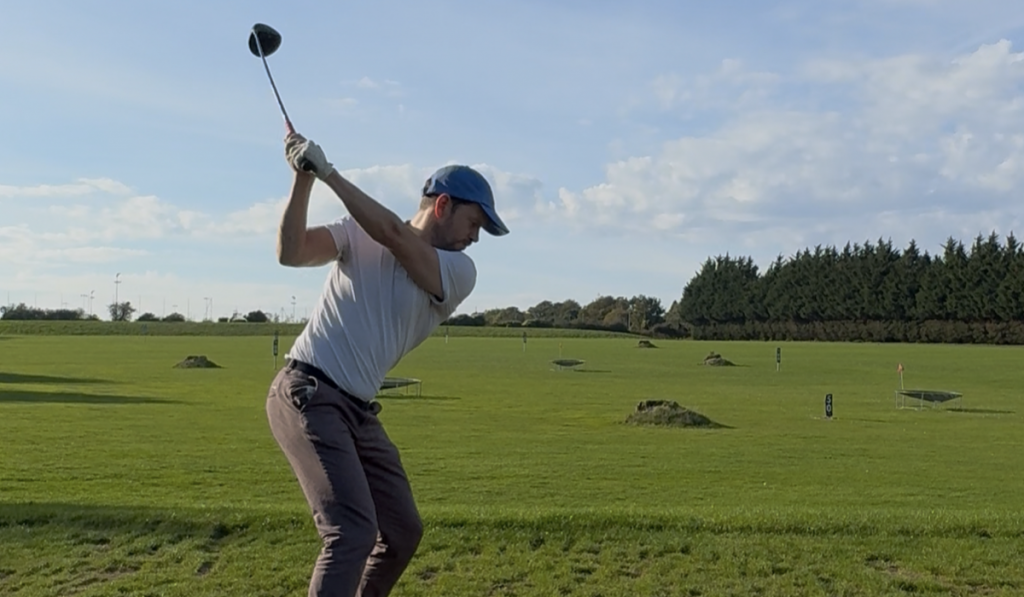
On the range, you can hit 50 wedge shots in 30-40 minutes – more reps than 20 hours of playing. You can isolate one skill, test different swing thoughts, and get instant feedback. The stable environment (consistent lie, same target) lets you learn what actually works.
The problem? The range isn’t like the course:
- No shot-to-shot variation (club selection, lie, wind)
- Less attention to where the balls finish
- No consequence for bad shots
- Golfers perceive shots as accurate when they’d be in trouble on the course (the range isn’t representative of the course).
This is why hitting great-feeling shots on the range doesn’t guarantee good scoring…
The Solution: Different Practice for Different Places
Accept that the range and course serve different purposes. There’s no gold medal for range performance.
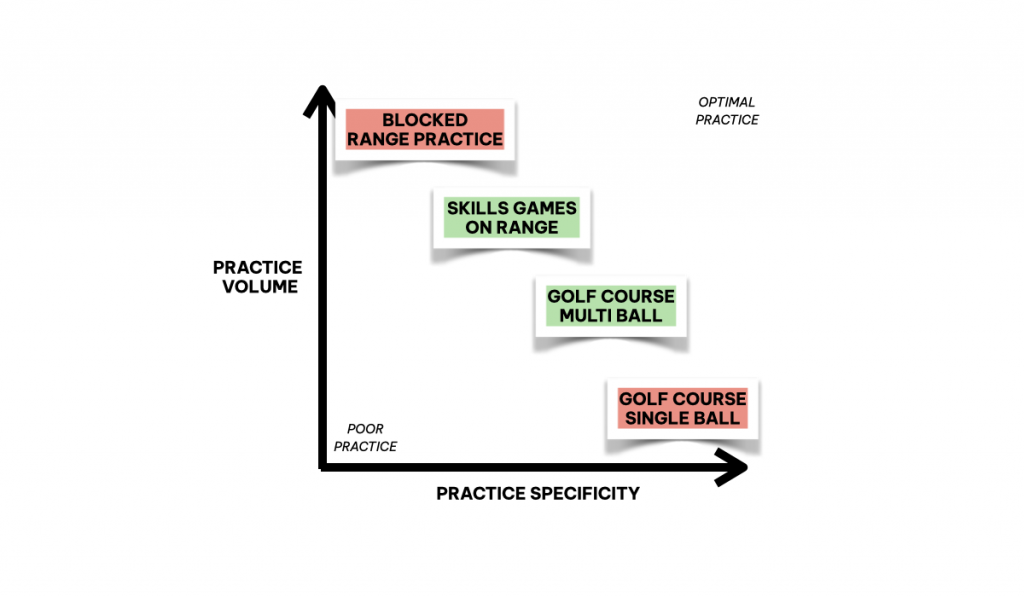
Your goal: Tweak how you use the range and the golf course to get the most out of both environments. You can do this simply by adding two new types of practice to your toolbox (shaded in green below).
How To Optimise Your Driving Range Practice
Blocked practice (beating balls and working on swing changes) has its place. But you also need practice with:
- More decision-making – Mix up shots and targets between reps
- Clearer feedback – Track exactly how far left/right shots miss and total distance
- Real consequence – Make good and bad shots matter (harder to create, but important)
With these elements, you’ll hit more bad shots on the range – but your on-course performance will improve faster.
The easiest way? Use skills games on the driving range, chipping green and putting green. Break X Golf analyses your playing stats and selects the best skills games to target your specific weaknesses.
How To Optimise Your On-Course Practice
The course’s problem is a lack of practice volume. Depending on how busy your course is, consider hitting extra shots when it’s quiet:
- Hit an extra drive off the tee
- Drop an extra ball at key yardages for approach practice
- Hit 2-3 extra chips around each green
- Hit 2-3 extra putts from key distances
This doubles or triples your shot volume without much extra time (be considerate – only do this when appropriate). If your facilities allow, this type of multi-ball on-course practice allows you get 2-3 times the practice volume on the golf course in almost the same amount of time.
The Complete Practice System
When you combine all four practice types effectivly you’ll really accelerate your rate of learning:
- Blocked practice on the range – High volume, stable environment: Great for building new movement patterns
- Skills games on the range – High volume with increased variability and planning: Great for building skill in an area
- Multiple balls on the course – Lower volume, highly specific: Great for transferring skills to developing decision making
- Single ball on the course – Very low volume, ultra specific: Great for testing your skills where they count
Summary
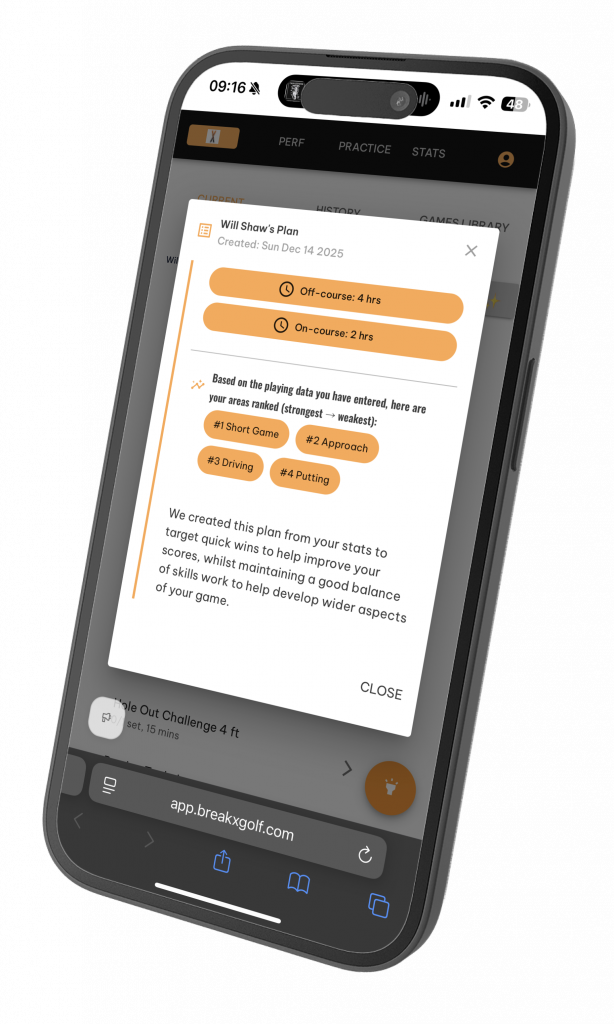
Optimising your practice can really speed up the rate at which you improve, but it is something so many golfers miss out on. Once you are working on the right areas of your game (something the Break X Golf app tells you: see below), it’s then a matter of getting your practice dialled in using the information above.
I hope you’ve found this article useful. Take some notes and think about how you can optimise your practice next time you hit the golf range.
Happy golfing – Will @ Break X Golf