

Most golfers practise regularly and still don’t improve. Not because they aren’t putting the time in, but because they’re practising in a way that doesn’t translate to lower scores on the course.
We’ve analysed thousands of rounds from amateur golfers and the data is consistent: golfers who practise with structure and track their stats improve at twice the rate of those who don’t. In this guide, we break down exactly how to practise golf in a way that works — from identifying what to work on, to building sessions that actually develop your game.
Why Most Golf Practice Doesn’t Work
Head to any driving range and you’ll see the same pattern. Golfers pull out their 7-iron and driver, smash a bucket of balls at some kind of target, then leave feeling like they’ve done something useful. Then they head onto the golf course, only to see their scores stay the same, or get worse!
The problem isn’t effort — it’s direction. Practising without knowing your weaknesses and dispersion on the course is like training for a marathon by randomly doing gym exercises. You might get fitter, but you won’t get a faster time unless you’re hitting the key limiting factors.
Our research shows that golfers who identify their weakest area and direct their practice accordingly lower their handicap at more than double the rate of those who practise without that focus. The fix isn’t complicated, but it does require a process.
The Four-Step Framework for Effective Golf Practice
Step 1 — Know What to Work On
Before you hit a single ball, you need to know which part of your game is costing you the most shots. This sounds obvious, but very few golfers actually do it.
The best way to find this out is to keep playing stats. Strokes gained data is the gold standard — it tells you precisely how many shots each area of your game (driving, approach, short game, putting) is gaining or costing you relative to your handicap level. If you’re not tracking strokes gained yet, basic stats like fairways hit, greens in regulation and putts per round will give you a clear enough picture to start.
Once you know your top-level weakness — say, approach play — the next step is to drill into the sub-areas. Is it your longer approaches from 150–175 yards, or your scoring zone from 75–100? Are you missing predominantly left or right? The more precisely you can identify the problem, the more targeted your practice can be.
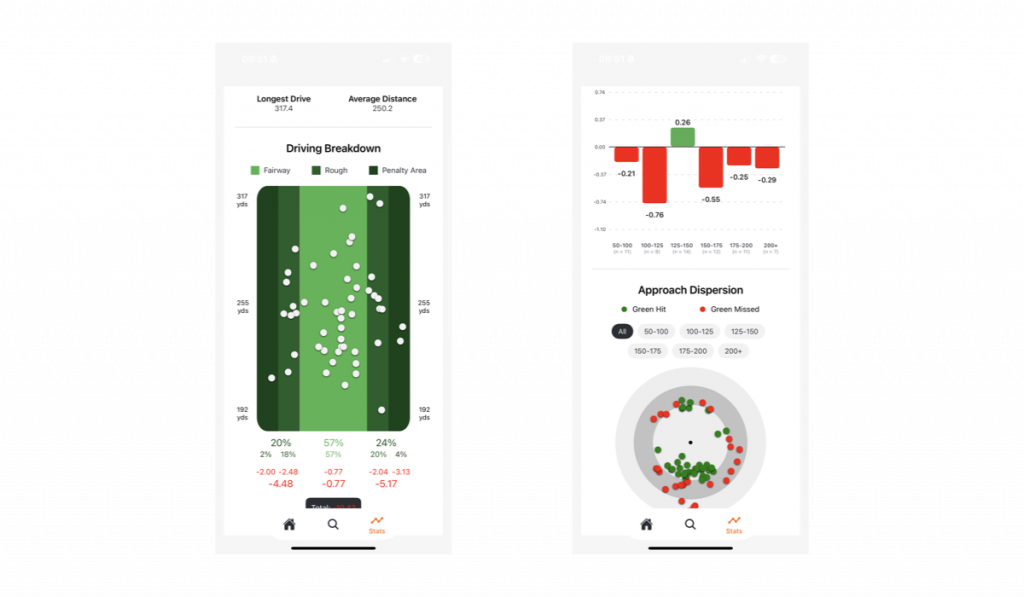
If you only have basic stats (fairways and greens hit, number of putts…) this task is a little harder, but it can still be done. Our golf stats by handicap guide shows exactly what performance looks like at every handicap from scratch to 25, so you can see at a glance where your game sits.
The goal of this step is simple: come away with a clear priority — ideally down to a specific sub-area, and some dispersion data — so that every session has a clear focus before it starts.
Step 2 — Structure Your Sessions
Once you know what to work on, you need to practise it in the right way. A well-structured session moves through four phases:
Warm-up (5 minutes) Start with a quick dynamic warm-up and some short, easy swings.
Technical practice This is where you work on improving your ball flight for your focus area (driving, approach, short game or putting). That might involve a specific swing thought, a position your coach has given you, or simply working on a shot shape or feel — hitting a draw when you’re used to a fade, or flighting the ball lower if you struggle with compression and strike. It doesn’t have to be heavily mechanical; what matters is that you have an intentional focus and clear feedback on whether the ball is doing what you want.
Skills games and performance challenges This is the section most amateur golfers skip, and it’s the one that transfers most directly to lower scores. Skills games are competitive challenges — hitting specific targets, completing sequences under pressure — that develop your ability to perform when it counts. They bridge the gap between the driving range and the golf course in a way that blocked technical practice alone never can. The goal is always to beat your last score. At the time of writing, we have 140 skill games in the Break X Golf app.
Pressure practice Finish every session by testing your skill under real consequence. Pick a target, set a score to beat, and go through your full pre-shot routine on every shot. This trains your brain to perform in the same way it needs to on the course.
For a full breakdown of how to build this structure into your weekly routine — including a free planning tool that does the work for you — see our golf practice routine guide.
Step 3 — Make Your Practice Measurable
One of the biggest differences between golfers who improve and those who plateau is measurability. If you can’t track whether you’re getting better at something, you have no way of knowing whether the practice is working.
Skills games solve this naturally because they have a score. Each time you play a game you get a number, and your job is to beat it. This creates a feedback loop that accelerates improvement far faster than hitting balls without a target.
Beyond individual games, track your key stats every round, or few rounds. Even a simple note of your fairways hit, greens in regulation and putts per round will show you whether your practice focus is paying off, however strokes gained data will really give you the best insight. When the numbers move, you know the practice is working. When they don’t, you need to adjust your practice.
Step 4 — Review, Update, Repeat
Your practice priorities should change as your game changes. The area holding you back at a 20 handicap is rarely the same area holding you back at a 12. Every few weeks — or after every three to four rounds — revisit your stats and check whether your focus area still makes sense. The Break X Golf app updates your practice priorities after every round you play automatically.
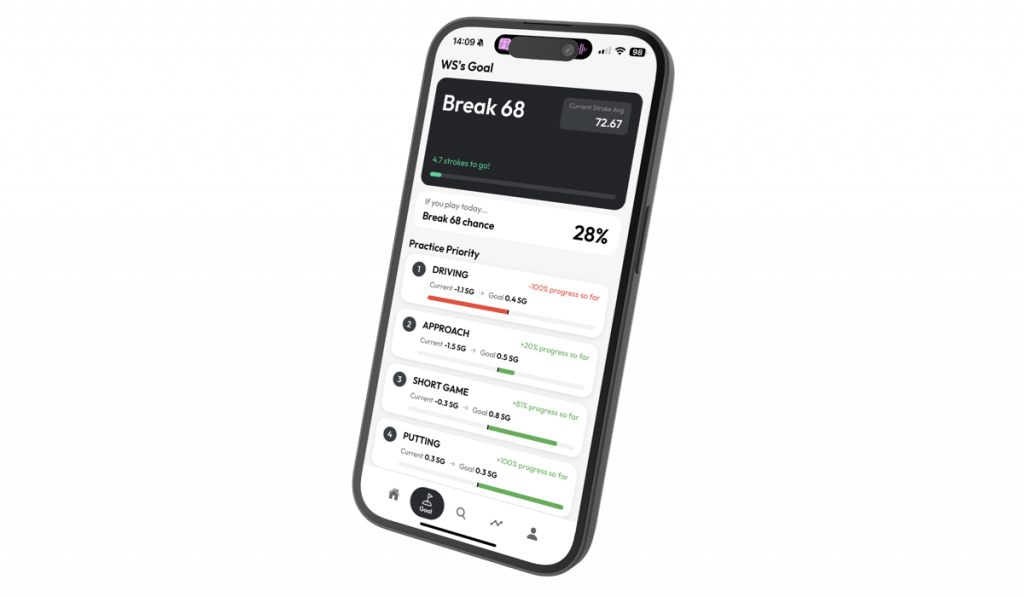
Our data from over 3,700 rounds shows that golfers who update their stats regularly and adjust their practice accordingly improve at more than three times the rate of those who set a plan once and never revisit it. The review is part of the process, not an optional extra.
Practising by Situation
The framework above applies whether you have three hours a week or thirty minutes. Here’s how to adapt it to different practice environments.
Practising at the Driving Range & Golf Course
The driving range is most players primary practice environment for practice. The biggest mistake golfers make here is treating it like a hitting session rather than a practice session. They work just on their golf swing technique, rather than working on improving their dispersion. The second error many golfers make is not making the most of the short game area and putting green – generally becuase they don’t know how to practice effectively when they leave the range. However, both of these areas represent areas most golfers can use to quickly improve by 2-5 shots, without much practice time!
Finally, use the golf course for practice – yes for practice. If you can head out when the golf course is quiet and practice hitting fairways and greens, practice not making bogeys, practice not missing any fairway right…there are so many ways you can get creative and improve your golf by thinking and playing differently.
Practising Golf at Home
Home practice is never going to match the golf course, but you can still make it useful — particularly for putting and short game. If you have a launch monitor, a lot of the best skills games translate well to a home hitting net/studio and allow you to keep your skills sharp during the winter or during bad weather.
Without a launch monitor, long game home practice is best focused on swing mechanics away from the ball — slow-motion rehearsal, mirror work, alignment drills — and on putting and chipping. The key, as with all practice, is to keep it structured and scored. Here’s a simple putting game you can play on any carpet or putting mat at home:
- Place two tee pegs 10 ft and 20 ft from your ball.
- Putt 10 balls. Each putt must land in the zone between the tees.
- The rule: every putt must travel further than where the previous ball finished.
- Miss the zone — or fail to pass the last ball — and that putt doesn’t count.
- Your score = how many putts land in the zone before you run out of space.
Practising with Limited Time
Short on time? Less is more than you might think. A focused 30-minute session on your single biggest weakness will outperform a two-hour session where you cover everything at low intensity.
If you only have 30 minutes, pick just technical work or go straight to skills games on your priority area. The competitive structure of a game keeps intensity high, and high-intensity practice in a short window beats low-intensity practice across a long one.
Building Your Own Practice Plan
Break X Golf is the best app on the planet for building you a personalised practice plan, full of skills games, technical practice all based on how you play golf.
If you’re new to all of this and not sure where to start, try our free practice planning tool below. You enter your handicap, rate the areas of your game, and tell it how much time you have — it builds you a structured weekly plan in a few seconds. You can even save it to your phone.
What’s your current handicap?
Drag the slider to set your handicap. Not sure? Take a rough guess.
Practice by Area
Looking to improve a specific part of your game? Here are our dedicated guides by area:
- Best chipping drills
- Best putting drills
- Golf driver practice guide
- How to practise golf in the winter
Happy golfing – Will @ Break X Golf