How many balls should you hit at the range? Or the putting and chipping green, for that matter…
Despite the vast amount of information on how to swing a golf club, this simple question still seems unanswered, and it feels like an important one. In this article, we’ll dive into what the science says about practice volume and what it means for your next practice session and how to plan your practice.
In our first article in this series, we learned that practice doesn’t automatically make you better, and that we can’t measure true learning until after your practice session. Here we’ll dig further into the concept of practice volume for optimising your learning.
Reps matter
Let’s start with the obvious: no one has got really good at golf without practice. There is certainly some transfer from similar skills (striking sports and general motor coordination), however no one will reach any high standard without a lot of practice (on the range and/or playing golf – both count!).
We need reps to generate adaptations that are required for improved skill level (build new and consolidate neural pathways, store new forms of knowledge that are later retrieved to perform the skill). The more reps we have at a skill, the more reason the body has to try and learn to perform that new task to a higher level.
Pick Your Practice Type Wisely
Playing golf is practice; it’s one of the best kinds of practice you can do. However, there’s a problem. In 4 hours, you’ll only hit 14 drivers, 20 approach shots, a handful of chips and 18 putts that aren’t tap-ins. Reps matter, so let’s consider you’re limited for time, how many reps will you actually get for improving a skill like your approach play?
Approach shots practice volume by time
- Playing golf: 1 shot every 12 minutes
- Performance challenges: 1 shot every 45 seconds
- Blocked/technical practice: 1 shot every 30 seconds
So if you are short of time and you need to improve your approach play (or any specific skill) consider what type of practice you should pick.
You can hit 24x the volume of shots in blocked practice in the same time, compared to playing a round of golf. The difference between performance challenges and blocked practice may not sound like a lot, but it’s still a 50% increase in shot volume – that is still huge over a period of months practicing.
As we’ll see in our next article, on practice specificity, both performance challenges and on-course practice have huge benefits, but the trade-off is how many reps you can fit into a practice session.
Is there a limit for how much we can improve With Practice?
There was a one-of-a-kind study in the 1950s that tracked how long it took factory workers to make a cigar on a production line (Crossman, 1959). Learning was fast at first, then slowed — but they were still getting quicker after 10 million repetitions! As far as we’re aware, if the conditions are right, there’s no real ceiling on how good you can get.
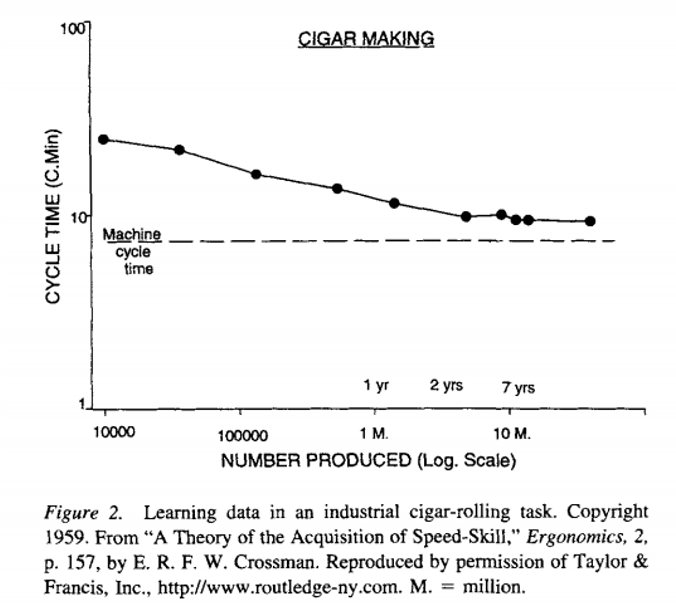
So as far as we are aware, if you have the ideal conditions to keep learning a skill, we don’t think there is a limit to how good you can get.
Skill Fade
When we don’t practice a skill, we lose some of our ability to perform that action. This is known as skill fade (use it or lose it).
It will affect every area of your game, but it’s not complexity that decides how fast a skill fades — it’s how automatic that skill has become, and what type of skill it is. Accuracy-based skills like putting, chipping and distance control fade roughly twice as fast as more automatic, speed-based skills like your driver swing. That’s why your basic swing pattern usually survives a lay-off reasonably well, but your short-game touch and feel disappear fast — and why beginners, who have nothing grooved in yet, lose ground fastest of all once they stop practising.
We all experience those miracle rounds when we hit the ball great after a long break (for other reasons we’ll cover), but generally, when we take a break from golf, our touch and consistency deteriorate first, well before our swing mechanics do. We then need reps to catch up to where we were before.
The more well-learned and automatic skills are, the less they tend to fade. Good news if you’re amazing and haven’t changed your swing for 20 years, bad news for the rest of us. But this should give you comfort if you’re improving quickly at golf, but then feel like you keep slipping backwards — it’s called skill fade, and there’s not much you can do about it, until your movements are more ingrained and feel natural.
The Power Law of Practice
There is one more key concept to share called ‘the power law of practice’. This law states that we see diminishing returns in skill improvement as we get better. As a beginner, 6 x 50 ball practice sessions will really help you improve your skill level. As a 15 handicap, it will help, but you’ll be unlikely to see the same level of improvement and as a +3 handicap, the same volume of practice will hardly improve your skill level.
This finding is ubiquitous across all sports, so just accept you’ll need more reps to keep reaching a higher level.
The Power Law of Practice
The same volume of practice produces very different results depending on your level
Beginner
24+ handicap
Every rep is teaching your body something new. 50 balls can produce a noticeable jump in skill because almost nothing is grooved in yet.
15 Handicap
Mid handicap
The same 50 balls still move the needle, but more gradually — you’re refining an existing pattern, not building one from scratch.
+3 Handicap
Scratch / elite
50 balls barely registers. Gains still happen, but at this level they need far more volume — or far more precise practice — to show up.
The Power Law of Practice is one of the reasons nearly all great golfers spend time on the range when trying to improve a skill or making swing changes. They need so many reps that it’s almost impossible to do it purely through just playing golf.
Where More reps Stop helping
More is better, but then why are there so many golfers who beat balls every week and just don’t improve? And some who practice and get worse?
This is really important to understand. There are three reasons why and when more reps does not equal more learning.
Loss of focus/fatigue
Because golf is a complicated, explosive movement, as soon as you get moderately fatigued, you should stop practicing. If you can’t generate a great swing, you’re unlikely to keep improving. The same is true if you can focus enough to plan a shot or pay attention to where it finishes. I currently would struggle to hit more than 60 balls in a practice session, before needing a break and most likely 30 drives in a session before I need a break. Learn your own limits and stick within them.
Injury Risk
As you practice for longer periods, you’re more likely to cause injury. Hitting 100 balls off a range mat generates a large amount of force through your wrists, elbows and shoulders*. And 100 quick golf swings in a row are a large load for your lumbar and thoracic spine if you’re not used to it. Injuring yourself with too much practice in one session is one of the best ways to make sure you’ll have a bad season and likely go backwards – be sensible.
*Unsurprisingly, the areas mentioned above are the most common injuries we see in golfers. Injury study data tells us that a large spike in ‘training load’ is one of the best predictors of injury. So, if you plan to start practicing more, please take your time to gradually build up from small volumes over time. (20 balls, 30 balls, 30 balls, 40 balls…).
Poor Quality reps
This is the real silent killer. Golfers who beat balls at the range are often just making lots of very poor quality reps. There is a monumental difference between the value of an okay rep and a great rep. As a beginner, you’ll learn by just attempting to hit the golf ball, but as you improve, each rep needs to be a higher-quality version than what you do currently. This means careful planning before each shot and detailed reflection after each shot.
Practice makes perfect permanent
And this is the reason you’ll find better players take far longer to hit 50 balls compared to less skilled players. Even though it reduces their practice volume within every practice session. What does a great rep look like? This is such an important topic that we’ll have a full article on it next in the series.
Key learnings
- More reps are better, but only when they are of a high enough quality!
- Picking the correct type of practice is one of the best ways to increase your practice volume
- Fit in as many reps as you can to a practice session, without losing focus or increasing your chances of injury.
- As soon as your body is too fatigued to generate a good golf swing – stop and take a break.
- As soon as you start to lose focus on where your shots finish or when planning a high-quality shot, you should also stop.
- To begin with, reps will move the needle, but as you reach teen handicap, single figures and below. It’s more about having high-quality reps, or you’ll barely improve.
How does The Break X Golf App handle practice volume?
If you’d rather not manage all of that yourself, this is exactly what the Break X Golf app does for you.
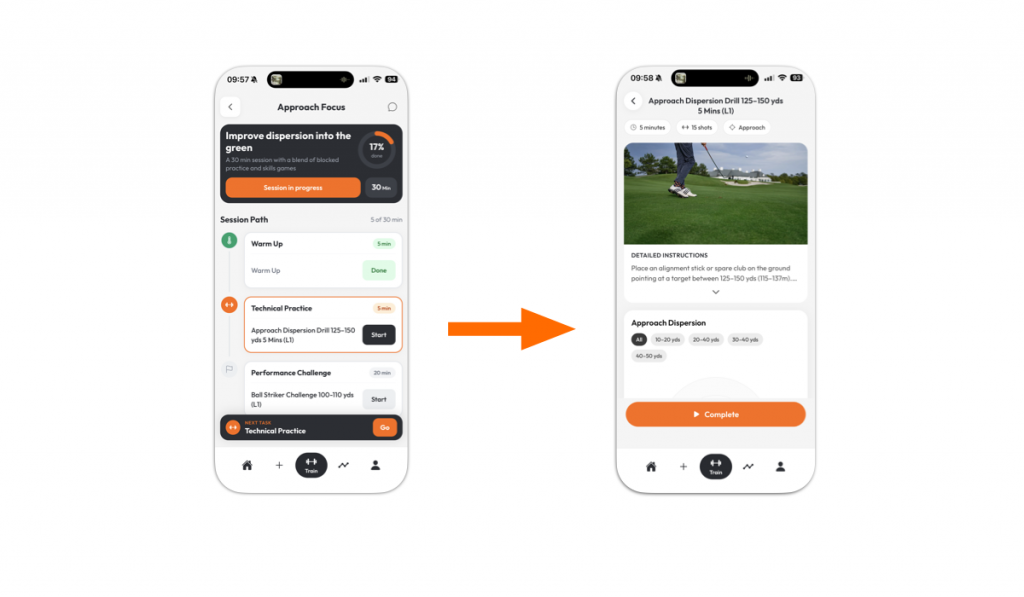
One of the biggest changes we made to the new mobile app is adding more blocked/technical practice to each session. Performance challenges are brilliant, but on their own they don’t always give you enough reps.
So now the app looks at (i) your playing stats and (ii) how long you have to practice, and splits that time between blocked/technical practice and skills challenges – automatically getting you closer to the right volume and mix, without you having to think about it. It works well for sessions between 30–90 minutes. This is V1 of the feature, so keep your feedback coming — we’re still learning what optimal looks like, based on the data, and we’ll keep refining it.
Happy golfing – Will @ Break X Golf