
In this article, we’ll cover what the data says about blocked vs random practice, what it means for you and how you can optimise your own golf practice.
Imagine being able to improve at golf more quickly with the same amount of practice. That’s what the research suggests. For the past 50 years, research has suggested ‘random practice‘ helps you learn quicker and more robust actions, but is it true?
What most golfers & coaches get wrong
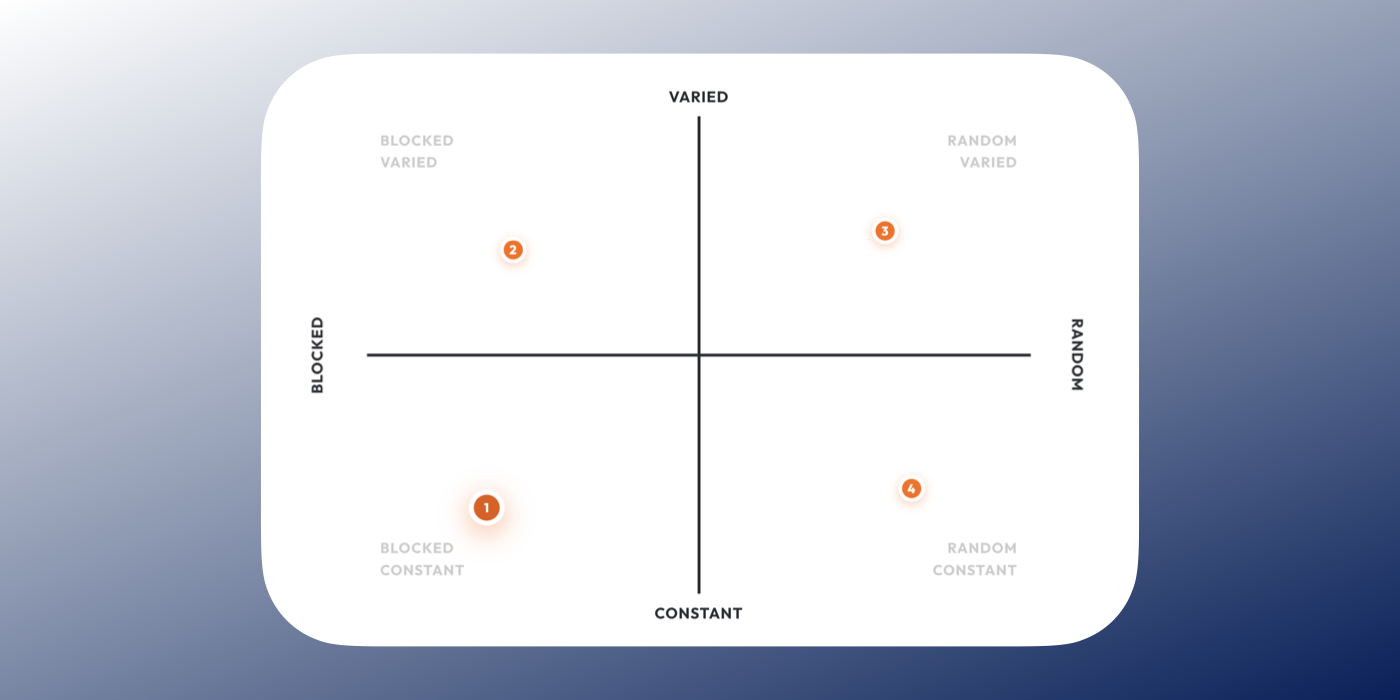
When you hear “blocked versus random practice,” most people are actually referring to two separate continuums that often get mixed up in conversation.
- 20 iron shots in a row
- Continuous putting drills
- Bunker shots only
- Drive → chip → putt → iron
- Simulating a full round
- Rotating between areas
This continuum is about switching between tasks — how much you move between different areas of the game.
- Same 6ft putt, flat lie
- Same chip shot, same lie
- Same 150yd iron, flat
- Chip from different lies
- Putts at varying distances
- Different iron distances
This continuum is about variation within a task — how much the conditions change while you’re practising the same skill.
Most golf conversations conflate these two. When coaches say “you need random practice,” they often mean varied practice. When they say “blocked practice,” they might mean constant practice. The research—and this is the key bit—shows that practising with more random or varied practice often outperforms more blocked and constant practice schedules.
However, the research is often focused on beginners learning a new skill, so do the findings still apply to you? We’ll explain how each form of practice can improve your own golf game and when to pick each one.
Here’s why this matters: you can hit 50 putting strokes from the same 5-foot distance (blocked, constant) or hit 50 putting strokes from 3 to 8 feet with different breaks and lies (blocked, varied). The second one is still “blocked” by traditional definitions, but it’s dramatically different in terms of what you have to do to hit each putt and what you will learn.
The first example allows you to set up. Hit ball after ball into the back of the hole and optimise your start line. The second example requires you to carefully plan every putt, read it, consider pace, then attempt to match what is required.
The second form is more complex; it tests different parts of your putting skill. It’s not always better, as it’s messy and you can’t get clear feedback on what caused poor putts – poor read, poor pace, poor start direction, poor stroke mechanics…
Both are useful and have their uses.
Understanding the Motor Skill at Play
Golf isn’t just about repeating a swing. It’s a perceptual-motor skill—which means three things happen in sequence:
- Perception: You gather information via your senses (distance, break, lie, wind)
- Decision-Making: Based on past experience, you decide what shot to play and make tiny tweaks (mostly subconscious) to your swing.
- Motor Execution: Your body performs the planned movement. It actually makes updates during the movement too, based on sensory feedback.
Here’s the crucial insight: blocked, constant practice trains mostly the execution piece. Varied, random practice trains perception and decision-making.
When you hit 50 6-foot putts from the same spot, your brain locks onto the motor pattern. You refine the stroke. But you’re not challenging your perceptual skills or decision-making.
When you hit 50 putts from different distances and breaks, your brain has to perceive new information, make a new decision every time, and then execute. It feels harder during practice—and it is. But it’s training a different aspect of your golfing skill.
The question isn’t which is better. The question is: what’s limiting your game right now?
Diagnosing Your Own Game
Here is a flow chart I’ve used for many years with players. It’s not perfect, but it’s a great guide to help you understand where to focus more of your practice time (you always need a blend of various practice structures).
Consider What You Need for Each Game Area
Different parts of your game demand different practice approaches. This is because some golfing skills are performed in a stable environment and require less decision-making, whereas others are performed in more varied environments and require more decision-making. Here’s a quick breakdown:
The Strategy: A Progressive Approach
Here’s how to put this together on your practice routine:
- Use Break X Golf app or your stats to work out what to practice.
- Consider if it’s a skill that needs a lot or a little decision-making.
- Start with blocked practice, see if you can hit 3-5 good shots in a row.
- Add in more variation to your practice as you progress, if the skill requires decision-making on the golf course.
Summary
Blocked versus random practice isn’t a binary choice. It’s a spectrum, and where you sit on it depends on:
- What’s actually limiting your game (execution vs. perception/decision-making)
- What area you’re working on (driving vs. short game have very different demands)
- Where you are in the learning progression (can you do it once, consistently, under variation, under pressure?)
Picking the right type of practice, at the right time, can make a big difference to how quickly you improve. Hopefully, this article has given you the tools to optimise your own practice.
Happy golfing – Will @ Break X Golf