
Whether you’re teeing it up in a club medal or chasing your first club championship title, tournament golf feels different. All those hours of range work suddenly need to transfer to where it counts.
The good news: how you prepare makes an enormous difference. The bad news…we can never guarantee success. However, what follows is the best way I know to stack the odds in your favour.
Here’s a practical framework — starting from three to four weeks out for a big event, or one to two weeks for a regular medal — that actually works.
In this article
Theme 1: Make Your Practice Harder Than Competition
Most golfers barely focus in practice, then wonder why they struggle when they turn their competition focus up to 11/10.
The best thing you can do before a tournament is make practice feel more stressful than the event itself. When competition finally arrives, it feels familiar — even easy by comparison.
Tighten your targets
If the average fairway is 30 yards wide, practise hitting into a 20-yard corridor. If you’re chipping goal is to get within five feet, make your practice target three feet. If three feet is the goal, try to hole it in practice. This principle applies everywhere — the range, the putting green, the chipping area.
When you play on the course in preparation, go off the back tees if the club allows it. Let the course feel harder than it will on the day.
Add pressure to your practice
It’s impossible to perfectly replicate tournament nerves, but here are some ways to get as close as possible. Practice skills games with a friend and put a drink or a small side bet on your skills games. The social pressure alone will change how you feel over the ball (and you’ll start to hit many more bad shots, that never normally come out in your practice).
If you’re practising alone, set a target score for skills games before you leave — and don’t leave until you hit it. Give yourself extra time, because you may need to play the game three or four times over. That’s fine. That’s the point.
The app has 130+ skills games built specifically for this kind of pressure practice — every one with a measurable target and the ability to track your scores and PBs over time.
Mark a card every time you play
This sounds almost too simple, but it works. When golfers play “casual” rounds in preparation, they take mulligans, skip shots, or move on without consequence. The moment you mark a card, the psychology shifts.
If you hit one into the trees, play a second ball as if it’s competition. Get comfortable with recovering and moving on. That habit will save you shots when it counts.
Theme 2: Know Your Course, Know Your Shots
Identify the shots this course demands
Two to three weeks before your event, think carefully about what the golf course will actually require from you. Long, straight driving? Controlled wedges into tight pins? Fiddly chips from deep rough? Long, undulating putts or lots of short breaking putts?
Think about it shot by shot. Will you be hitting lots of long irons and hybrids into greens, or lots of wedge shots? What short game situations will come up most? Go and practise those exact shots until you feel dialled in.
What does your course demand?
Select the shots your upcoming course will require. We’ll rank your practice priorities so you’re spending time on what actually matters.
Select shot types above to generate your practice priority list.
Work on dispersion on the range — play with what you’ve got on the course
This is one of the most important distinctions in tournament preparation, and most amateur golfers get it backwards.
On the range, yes — work on your patterns. If you’re leaking drives to the right, spend some time understanding why and tightening that dispersion.
But when you’re on the golf course trying to score — or indeed on competition day itself — play with what you’ve got and allow for your shot shape. If your ball is going slightly right that day, aim left and play for it. If all your chips are finishing shot, aim to run each one 3 ft past the pin.
The best tour pros do this routinely. If they’re missing right on a given week, they factor it in to every tee shot and approach. They don’t try to fix their swing between shots, they manage the golf ball around the course.
Break X Golf App
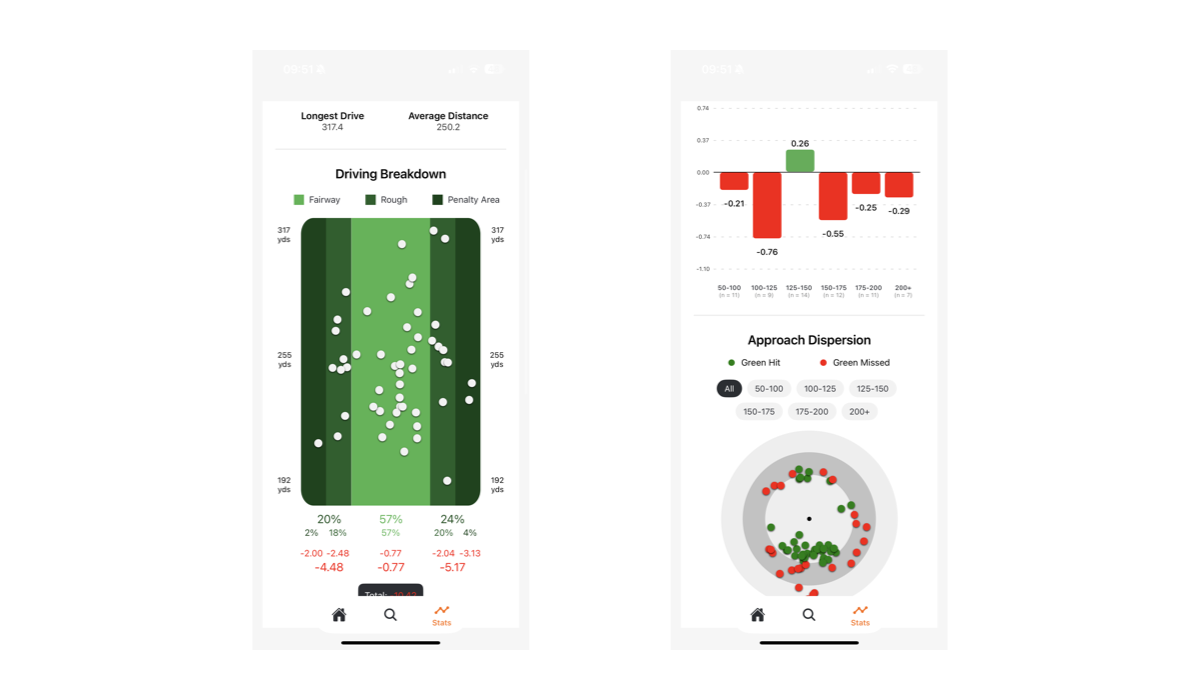
See exactly where you’re leaking shots — before your next event
Your driving dispersion, approach patterns, and strokes gained data, all in one place.
Practice strengths and weaknesses — but always have a fallback
Split your preparation between the areas where you’re strongest and the areas that need work. Practising your strengths builds confidence, which is genuinely useful before competition. Practising your weaknesses improves your floor.
But here’s a key addition: for any area of your game that’s fragile, have a fallback shot ready. If your driver is unreliable, what’s the shot that gets you in play 90% of the time — a three-wood, a cut? If you struggle around the greens, can you rehearse a bump-and-run, or a putt that just gets the ball on the green?
Having a plan B stops fragile shots from unravelling your scorecard.
Theme 3: Short Putts Don’t Win Competitions, But They Do Lose Them
If there is one area to prioritise without question, it’s putts inside five feet. Club golfers miss these far more often than they realise. A topped 5 wood may feel embarrassing, but it will likely only cost you 0.5 of a shot. Whereas every putt you miss inside five feet costs you almost a full shot!
Strokes gained perspective
A missed short putt costs twice as much as a topped 5-wood
Your 5-wood gets an hour on the range. Your short putting gets five minutes on the practice green. This is the single highest-return area you can work on before any competition.
Make holing short putts under practice pressure a non-negotiable part of your preparation. 20 In A Row Putting is one of the best ways to practice this area in under 10 minutes.
Theme 4: Sharpen Your Mechanics Without Changing Them
A GAP Session Keeps Your Fundamentals In Check
One of the quickest ways to play bad golf is for your fundamentals to drift without you noticing. Grip, alignment, posture — and ball position — are the things that quietly go wrong and make everything else feel broken (so many golf lessons I’ve given focus on just correcting posture and ball position and letting the golfer make swings to regain their form).
As you prepare for a tournament, you’ll be playing skills games and spending time on the golf course, but it’s important to keep the basics in check. In the Break X Golf app we call this a GAP session. Set out a couple of alignment sticks (or golf clubs) to check aim and ball position and just hit some shots to keep these in place.
Great for your long game and don’t forget to do the same for your putting and chipping practice too.
Use block practice to find your feelings
This might sound counterintuitive when so much of good preparation involves pressure practice and on-course play. But there’s a place for block practice too — specifically for finding clear, simple feelings you can rely on for each part of your game.
You’re not trying to rebuild your swing. You’re trying to distil what works into something you can recall under pressure. A feeling for your driver. A thought for your wedge. A cue for your putting stroke. Block practice is where you find those anchors.
Theme 5: Developing The Right Mindset
Get clear on your pre-shot routine — For all Shots
Golfers are often very diligent about their pre-shot routine on the tee and with full shots, but they neglect it for chipping and putting. Under pressure, your routine is what frames the decisions you make and keeps you focused on your goal.
In practice, spend time playing skills games using your full routine on every shot. Get very clear on what you are doing, what you are thinking to make sure you have clarity over the golf ball.
(Want a full breakdown of building a tournament pre-shot routine? Let me know — I’ll write it up as a follow-on piece.)
On the Day: Warm Up to Warm Up, Not to Fix Your Golf Swing
Your competition day warm-up has one job: get you loose, build confidence, and find out where the ball is going today.
It is not the time to work on technique. Whatever you find in the warm-up — whether your driver is drawing a little more than usual or your irons are flying slightly right — that’s the information you take onto the course. You play with it. You aim for it.
Warm ups are rarely/never perfect, but golfers who struggle most on competition day are the ones who spend their warm-up trying to fix things.
Your pre-tournament checklist
Ready to put this into practice?
The framework above gives you everything you need to prepare well. If you want to skip the manual tracking and let the data tell you where to focus — Break X Golf will review your strokes gained, identify your weakest area, and build you a preparation session automatically.