
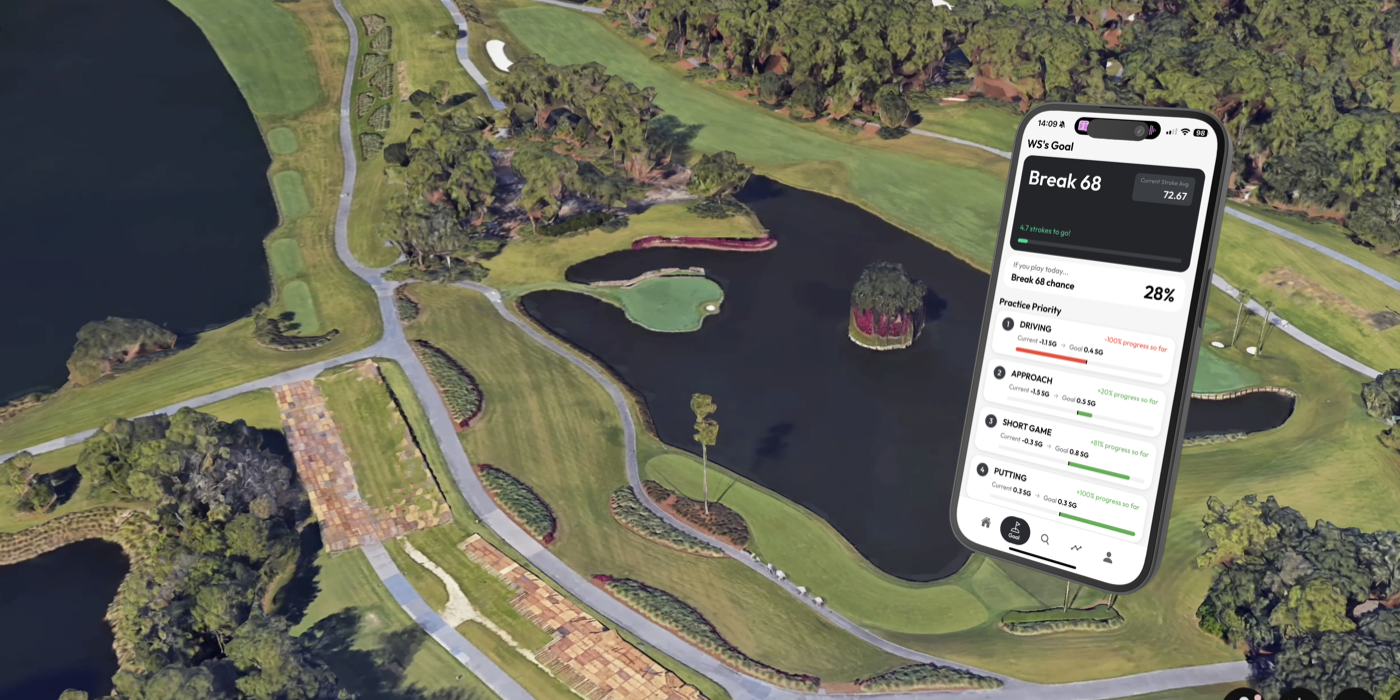
You’ve been playing off the same handicap for the last year. You practice regularly. You’ve had lessons. You watch YouTube videos. But your scoring average refuses to budge.
Sound familiar?
Most golfers set goals (“I want to break 80”), but have no systematic way to get there. They practice what they enjoy or what they think they need, hope it transfers to the course, and feel frustrated when the scorecard doesn’t reflect the effort.
Breaking your target score often isn’t about practising more. It’s about having a clear system that tells you exactly what to fix, by how much, and whether it’s working.
This is the 5-step process I use with every golfer I coach.
“We don’t rise to the level of our goals. Instead, we fall to the level of our systems and processes“
Why Most Goal-Setting Fails
“I want to break 80” is a goal, not a plan. It doesn’t tell you:
- How many strokes you need to find
- Where those strokes are leaking
- What “good enough” looks like in each area
- Whether your practice is working
Without this clarity, you’re guessing. And guessing means wasted practice time on areas that aren’t your biggest leaks.
The fix? Convert that vague goal into a deterministic system where each improvement in practice predictably lowers your scoring average.
The 5-Step System
1. Define Success in Strokes
Your goal needs to be specific and measurable. “Break 80” means shooting 79 or better. Setting a stroke average target of 79.0 (for 3 rounds) means if you reach that target, you’ll be sure to reach your goal too (yes, you should hit your goal before you hit the 79.0 stroke average).
Here’s how to turn your goal into a plan:
- Pick your goal score (e.g., 80)
- Calculate your current stroke average from your last 3 rounds
- Measure the gap
Example:
- Goal: Break 80
- Target stroke average: 79
- Current average: 89 (from last 3 rounds)
- Gap: 10.0 strokes to find
If you have a handicap target and are wondering how to convert it into a stroke average goal, just use the tool below. There is a near-perfect correlation between stroke average and handicaps.
Target Stroke Average Calculator
Convert your handicap goal into a specific stroke average target
What this means: If you shoot 89 or better consistently (averaged over 3+ rounds), you’ll achieve your 15 handicap goal. The +2 adjustment accounts for the difference between handicap index and typical scoring.
Now you have a concrete target. You need to work out where you are going to find these additional shots from. But where?
2. Find Your Biggest Leaks
This is where Strokes Gained becomes very useful. SG measures your performance in each area—Driving, Approach, Short Game, Putting—against a benchmark.
Here’s the critical insight: If you improve by +1.0 SG in any area, you lower your stroke average by exactly 1.0.
That means if you need to find 10.0 strokes, you need to gain 10.0 total SG across all areas of your game.

Track your stats and rank your areas from weakest to strongest.
To do this, simply rank your strokes gained data from min to max (it doesn’t matter what handicap benchmark you use).
Below is some example SG data (vs PGA Tour) for our golfer with a 89.0 stroke average who wants to break 80.
Starting SG Total: -19:
- Approach: -7.4 SG 🔴 (Biggest leak)
- Driving: -5.1 SG 🟡 (Not great)
- Putting: -3.3 SG 🟢 (Current strength)
- Short game: -3.2 SG 🟢 (Current strength)
Now we know exactly where strokes are leaking: primarily from their approach play, followed by driving. With this data, we can now create a clear plan to reach our goal:
Strokes needed = 10.0 (to jump from 89 to 79 scoring average)
Strokes Gained goal = -19 to -9
Target SG -9
- Target Approach = -3.4 SG
- Target Driving: -3.1 SG
- Target Putting: -1.8 SG
- Target Short game: -1.7 SG
Now we just need to close the gap between the current strokes gained numbers and the target strokes gained numbers.
Key point: Don’t practice what you enjoy or what you’re already good at. Practice what the data says you need to fix.
Bonus Tip: Use Dispersion Data To Work Out How To Improve
Now that you’ve ranked your weaknesses, focus on the biggest leak first. In our example, that’s approach shots and driving.
But “practice approach shots and driving” is still too vague. Strokes gained data tells you what to practice, dispersion data tells you how to improve that area.
If you can, look at the direction of your misses in each area to tell you how to improve. There is a lot of data below, but you can see in the driving data below (left image) the misses are slightly more to the right, and the strokes gained values for right misses are slightly worse – so this right miss is costing the golfer.
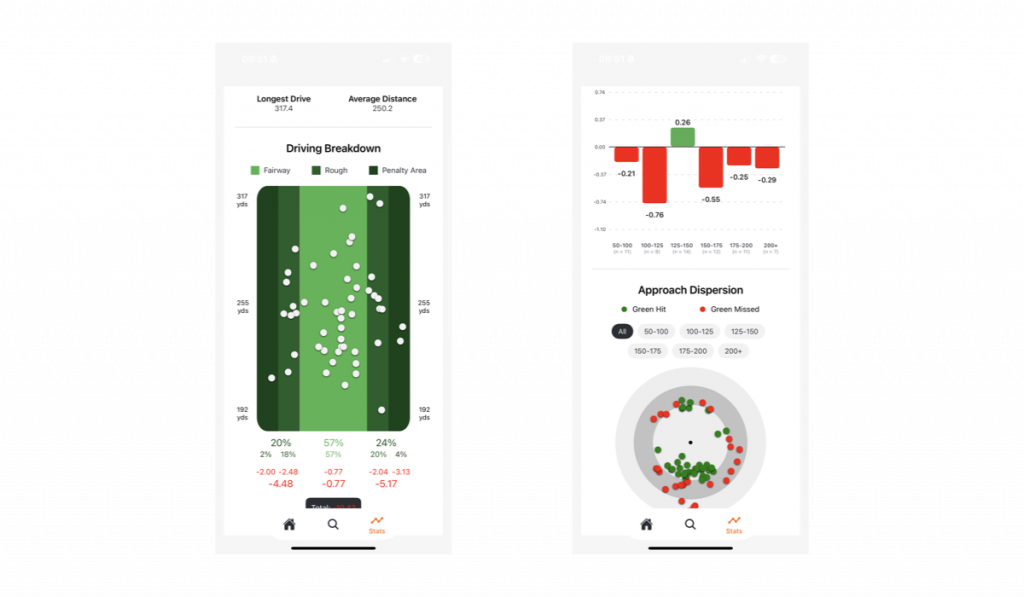
There’s a similar pattern for approach play (right). It is subtle, but more shots are missing right. You’ll also notice distance control is an issue – there are very few shots perfectly pin high.
This data is very valuable for telling you how to get 10 shots better. You need to find a way to get more shots closer to the target. I know that is obvious, but few golfers take time to look at their data and properly analyse where they are missing.
3. Practice What Matters Most – Building Your System
Once you have done your analysis, it’s time to focus fully on your systems and processes for improving those areas, namely, great practice and play. The exact mix you need will vary over time, but here is a general guide.
1. Technique Work (10-50% of practice time)
- Fix the mechanics that cause the poor shots (ideally with a great coach)
- Example: Approach shots and driving are missing right
- Work on: Club face control & start line
- Technique practice volume should reduce when changes start feeling natural
2. Performance Practice (20-50% of practice time)
- You need lots of reps, and the golf range is ideal for this
- Repeat the same shot with key clubs to build consistency
- Example: 20 balls to the same target at 150 yards
- Focus: How close can I hit it to my target
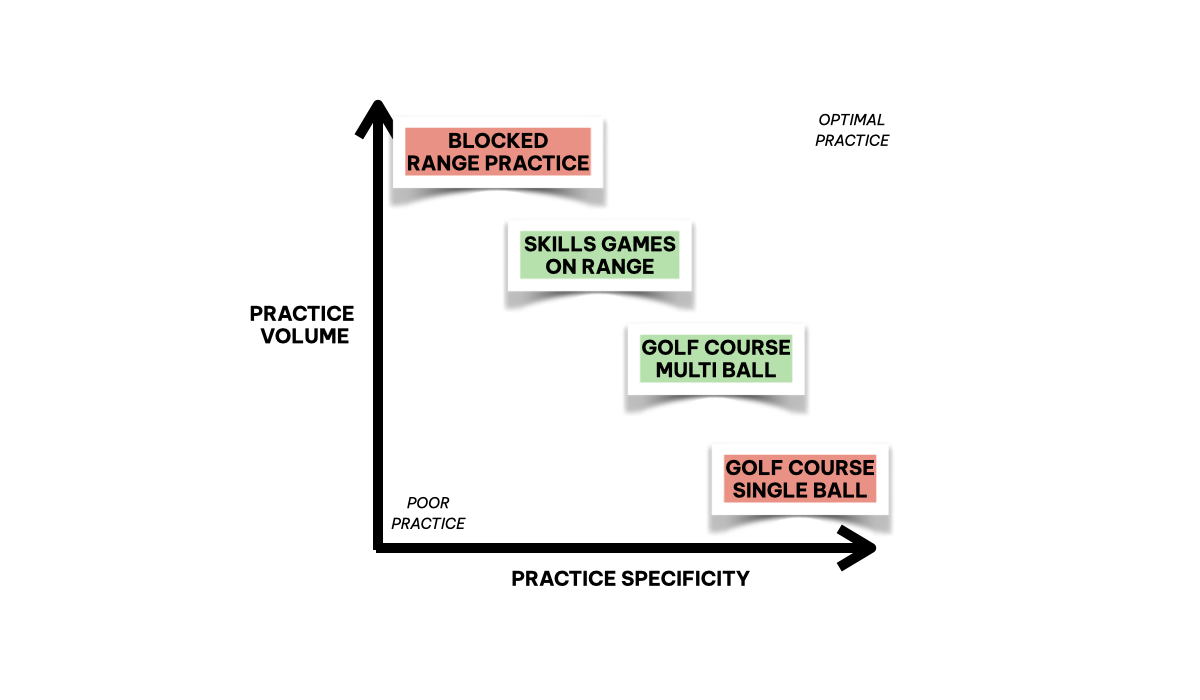
3. Skills Games (20-50% of practice time)
- Structured challenges that measure performance
- Example: “30 Ball Approach Play Challenge” – score points for proximity to target
- Why this matters: More representative practice and tracks improvement
4. On-Course Transfer (10-50% of practice time)
- Deliberate focus on that area during rounds (if quiet, get in some additional shots)
- Example: On every approach, focus on target & club selection and reflect on where shots miss
- This helps transfer your range game onto the golf course
- When you can perform on the range and in skills games, it’s time to ramp up on course practice
The Leading Indicator:
Your skills game scores improve 2-4 weeks before your on-course performance.
If you’re tracking scores in skills games and seeing improvement, you’re on the right track even if your course scores haven’t dropped yet. Trust the process.
4. Update and Measure
After every rounds update your stats. Analyse your data in sets of 3-5 rounds. This tells you:
- Is the area you’re practising actually improving?
- Should you shift focus to the next priority?
- Are you on track to reach your goal?
Example of updated data:
| Area | Current SG | Target SG | Gap | Status |
|---|---|---|---|---|
| Approach | -6.2 | -3.4 | 2.8 SG needed | 🔴 Priority 1 |
| Short Game | -3.1 | -1.7 | 1.4 SG needed | 🟡 Priority 2 |
| Putting | -2.1 | -1.8 | 0.3 SG needed | 🟢 Later |
| Driving | -3.0 | -3.1 | 0 SG needed | ✅ Maintain |
As you play, just keep focused on where the biggest gaps are and practice those areas. In the example above, approach play is still the biggest focus, but driving has made some great improvements, so our practice plan should focus more on approach and short game.
5. Repeat Until Goal Met
This isn’t a one-time exercise. It’s a continuous cycle:
Measure → Prioritise → Practice → Update → Repeat
Keeping on top of this ensures you’re making the quickest progress towards your golfing goal.
How To Get Started
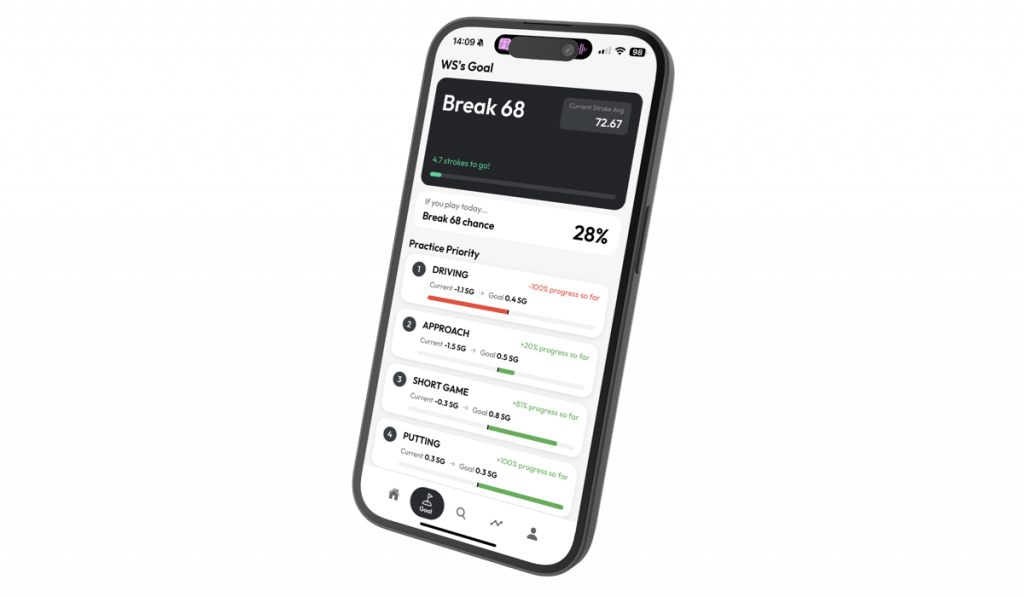
You can do all of this yourself. If you have a strokes gained app, you’ll have data. If not, we have a free strokes gained calculator here you can use. However, this is what we are building at Break X Golf.
- The new native app (beta) allows you to set a goal and collects strokes gained data for every round you play.
- The web app and native app rank the areas of your game from strongest to weakest (screenshot above).
- The web app builds great practice plans based on this data, and soon the native app will give you even more data-driven plans.
- Both apps continually update your strokes gained data with every round you track.
We’ve still got more work to do to make this a seamless process, but if you have a subscription to Break X Golf and would like early access to the beta native app, just reply to any of our emails, and I’ll add you to the testing group.
Quick Summary
Whether you use the app or do this manually, the process is the same:
- Set a specific stroke average target & measure your current stroke average (not just “break 80 someday”)
- Track your stats and rank your weaknesses using Strokes Gained
- Practice the biggest leak first with structured drills and skills games
- Update after 3-5 rounds and measure if practice is transferring to course performance
- Repeat until each area reaches the target set
Remember: Each +1.0 SG improvement = 1 stroke better average. It’s deterministic, not random.
Happy golfing – Will @ Break X Golf