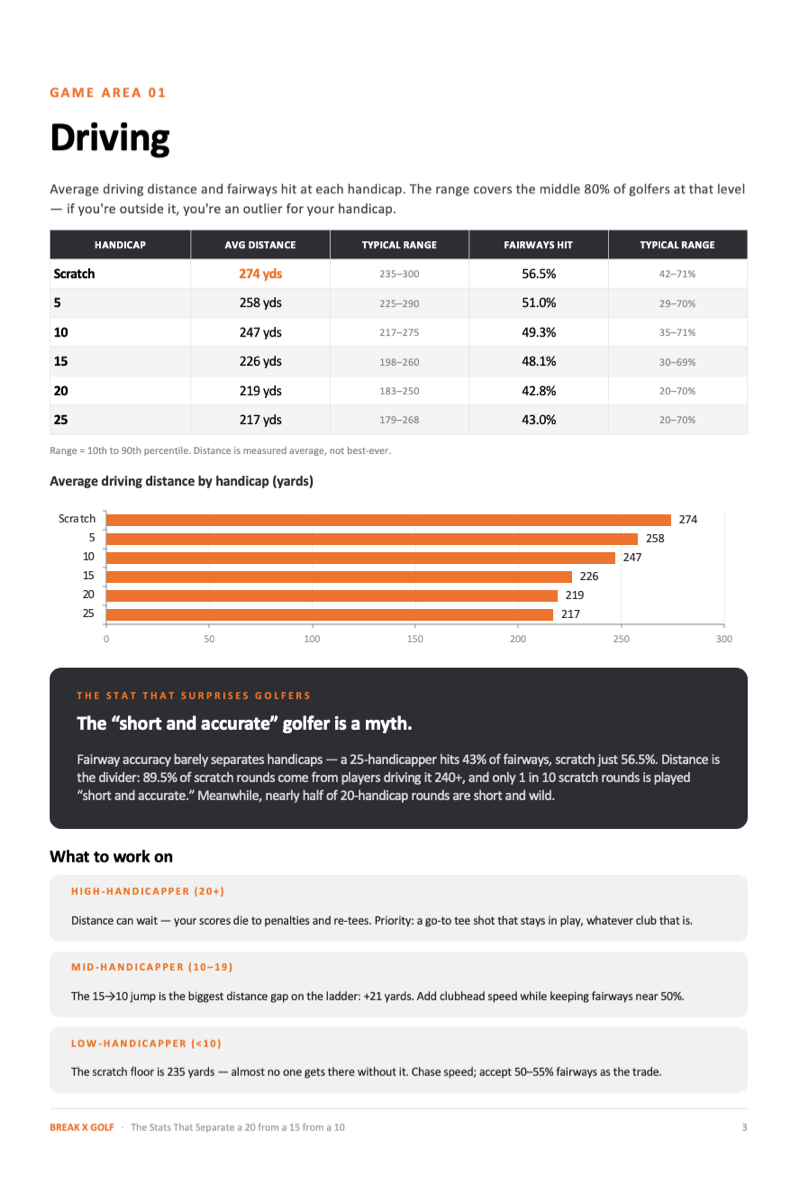
We all want to make more birdies. But that’s not what actually leads to shooting lower scores.
When you look at scoring data across handicap levels from 25 to scratch. What we see is that better golf is all about fewer errors.
While strokes gained data and greens hit in regulation…are all very useful, there is a simple set of numbers that perfectly predicts your handicap, and I think it’s often overlooked – your average number of birdies, bogeys and double bogeys (or worse) per round.
In this article, we’ll benchmark average birdies, bogeys and double bogeys for different handicaps, then share useful tips to help you actually hit the numbers you need to reach your goal. To start, let’s look at some headline numbers – the difference between 25 handicaps and scratch golfers.
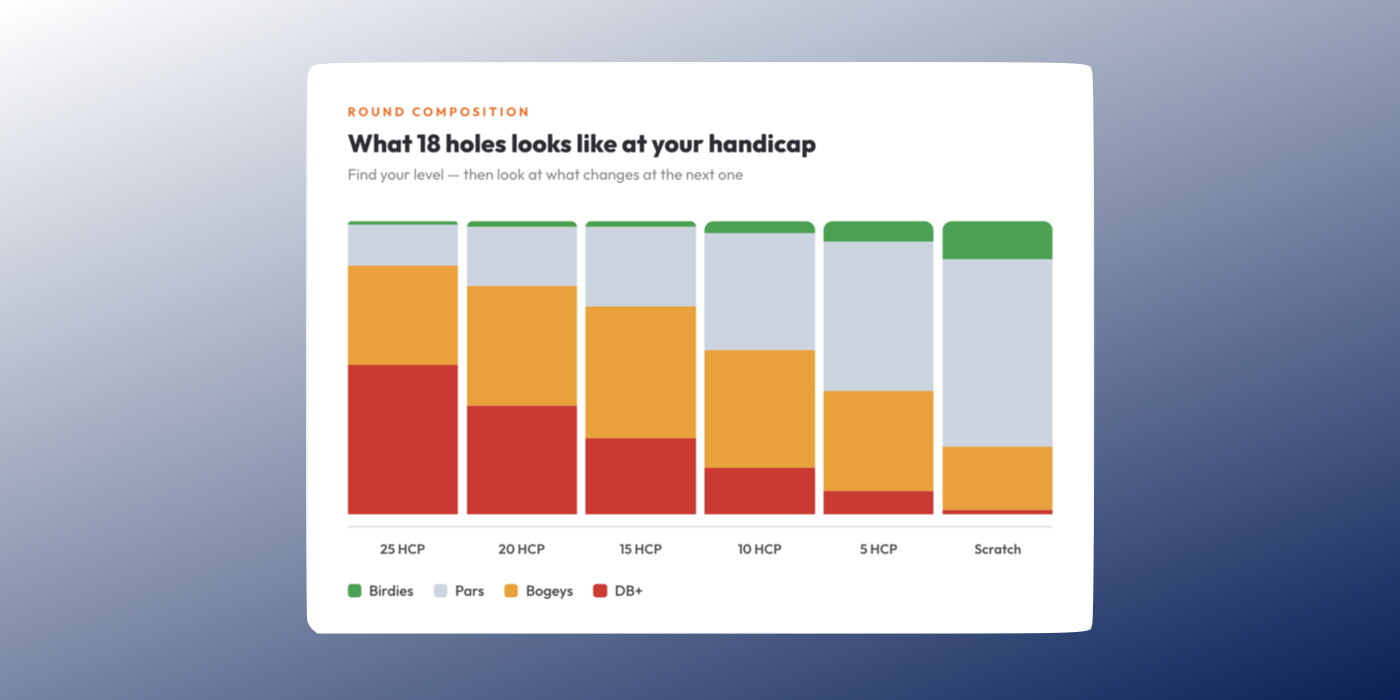
Going from a 25 handicap to scratch, birdies increase by just 2.16 per round. But double-bogeys and worse (DB+) drop by 8.91 shots per round.
The hidden tax on Bogeys & DB+
Every DB+ costs you a minimum of two shots above par in a single hole. But these also cause additional damage. A double bogey at the 5th changes how you play the 6th. You start pressing to recover. Your decision-making shifts from disciplined to desperate. And the next big number often follows.
A 25-handicapper averages 9.18 DB+ per round. A scratch golfer averages just 0.27, and at every handicap level, there’s a consistent drop in this value. Golfers should spend more time than they do considering how and why they make their double bogeys (we cover this in a minute).
What your round actually looks like
The line chart version makes the divergence even clearer: as handicap drops, DB+ falls sharply, bogeys rise up, then fall, and birdies barely move. The variable you’re probably not focused on is the one that matters most.
Let’s cover some practical ideas for how you can reduce your number of double bogeys.
8 rules For Fewer Double Bogeys (that have nothing to do with being more talented)
These are not tips on how to hit better shots. They are decisions that remove DB+ from your round.
They’re all simple, but not easy to do in practice – but they really do work.
1. Aim away from danger off the tee — even if it means the rough
OB and water hazards are the most direct route to a DB+. Three off the tee is a round-wrecker that takes two shots to recover from, minimum. Before every tee shot, if there is real danger on the hole (OOB water, or thick bushes) pick a landing area that avoids it completely — even if it costs you distance or puts you in the rough. A ball in the rough 200 yards out is a recoverable position. A ball in the penalty area is not. Pros and top amateurs do this frequently on tough golf courses.
2. If you’re not comfortable with the driver, leave it in the bag
Being further down the hole is usually a benefit, but how many times can you remember feeling uncomfortable over the golf ball and actually managing to hit a decent golf shot? Almost never.
If your 3-wood or hybrid gives you 80% of the distance and significantly more control, use it. If you’re a high handicap and you just can’t hit your longer clubs, hit a 6 iron off the tee, then work on it after the game on the range. Pick the club you trust and get the ball in play.
3. When advancing the ball, choose solid contact over distance
If you are not going to reach the green, the only objective is to make clean, controlled contact and move the ball forward. Pick the club that gives you the best chance of a soild strike, not the one that might just get there. A smooth 7-iron that advances you 140 yards puts you in a far better position than a forced 5-wood into trouble. A chip and a putt for par is great, bogeys are not the end of the world, even for scratch golfers.
4. In trouble? Chip out. Accept the shot. Move on.
“Don’t follow a bad shot with a stupid one.”
This is the most important rule on this list and the hardest to consistently follow. When you’re behind a tree, in thick rough, under a bush, or on a difficult lie with no clear route to the green — take the safe option, get back in play, and make bogey, you never know, you may make a miracle par.
5. From outside 90 yards, aim for the middle of the green — every time
If you’re a 6 handicap or above, this one decision alone could save you two or three shots per round. Aiming for the centre gives you the maximum margin for hitting the green in terms of length and lateral error. Greens in regulation (GIR) is one of the strongest predictors of scoring at every handicap level, and you can dramatically increase your GIR rate simply by moving your target from the flag to the middle of the green.
6. Pick one chip shot and use it by default
Within 30 yards pick one reliable, low-risk chip (a simple running shot with a 7-iron, 8-iron, or Pitching Wedge) and default to it whenever the lie allows. Boring and functional beats creative and unreliable. Hitting a 2nd chip is one of the quickest ways to make more double bogeys.
7. In a difficult lie near the green, your only target is the putting surface
When you are in a bunker, a tight lie, thick rough, or any tricky position near the green, your sole objective is to get the ball onto the putting surface and give yourself a putt. Forget the flag. Forget leaving it close. Get out, two-putt, make bogey, and move on. Play a sensible chip and let the putt be the hero – that’s a saying they use in England Golf Junior Regional coaching.
8. Get world-class at putting inside 5 feet
This is the one area where every golfer, regardless of age, fitness, handicap can reach an elite standard. Spend 10 minutes weekly practising putts from 3 to 5 feet. In the Break X Golf app we have ’20 In A Row Putting’ which does exactly this.
Can you make 20 3-foot putts in a row? It sounds simple, but it isn’t, and every 3-foot putt you miss costs you precisely one full shot.
Track it, because you can’t manage what you don’t measure
Most golfers have a vague awareness of how many birdies, bogeys and double bogeys they make, but without tracking DB+ specifically, you cannot see where in your round they are happening, how often, or what’s causing them. Is it off the tee? From a particular distance? In certain conditions?
We built the Break X Golf mobile app so you can see how many you make, but by simply tapping on the scorecard, you can see exactly how you made that error.
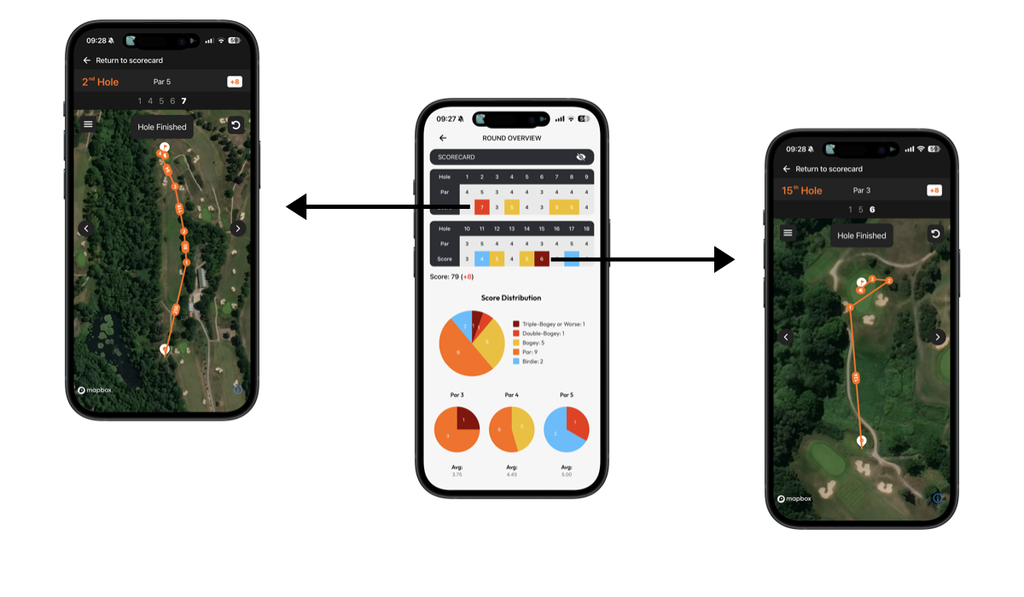
At the time of writing, we’re super close to the full release in the app store, but for now, every golfer with a subscription gets free access to the beta app as we’re building. You can download it here.
If you don’t have a subscription, you can sign up via our web app. Once you’ve started your 7-day free trial, you can follow the link above and use your login details to access the mobile app.
⛳ A Challenge for Your Next Round
🔷 High-Handicapper (15+): Before each tee shot, identify where the danger is (OB, water, thick rough) and commit to a line that avoids it entirely — even if it means using a shorter club or aiming into the rough. Count how many times you are OOB, in water or have a lost ball off the tee and note it after the round. Reduce the number on your next round.
🔷 Mid-Handicapper (7–15): Every approach from outside 90 yards, aim for the centre of the green regardless of pin position. No exceptions this round. Track how many greens you hit and compare it to your average.
🔷 Low-Handicapper (<7): Track your DB+ this round and write down the situation that caused each one. After the round, look for the pattern. Was it off the tee? Around the green? A poor decision compounding an error? That’s your next practice focus.
Happy golfing – Will @ Break X Golf