
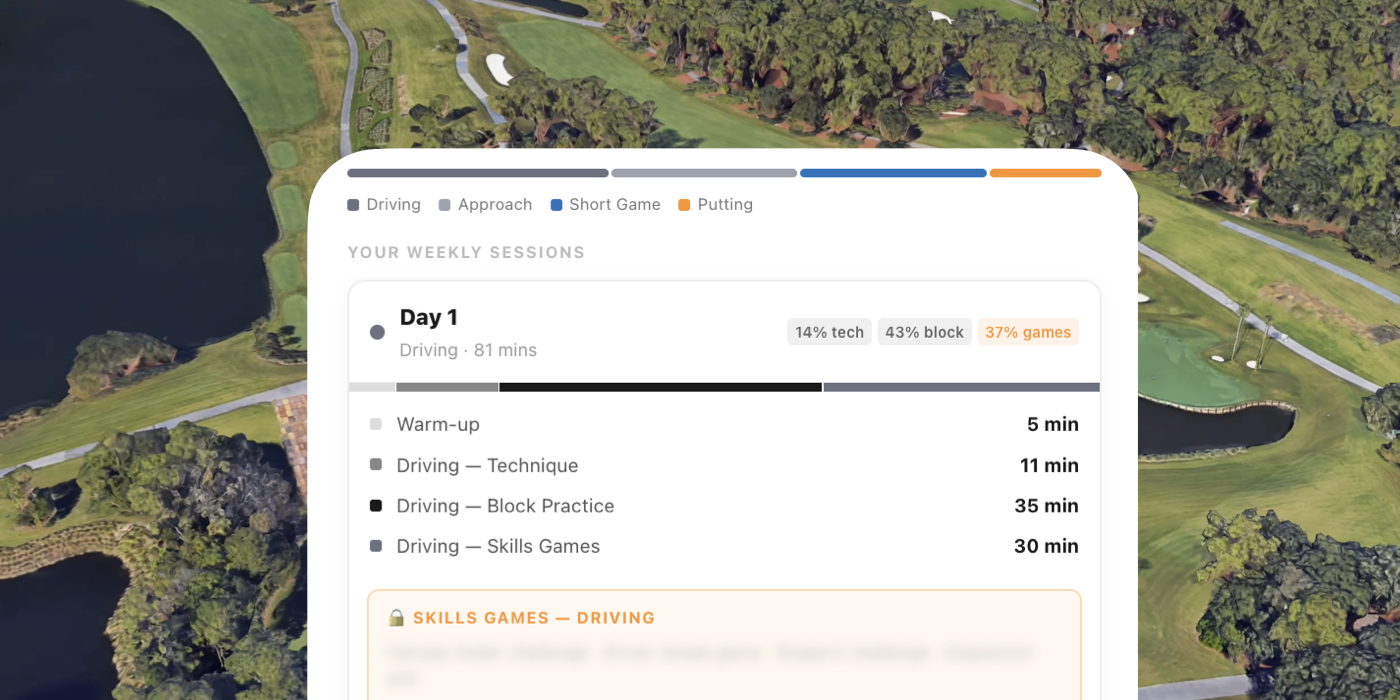
What’s your current handicap?
Drag the slider to set your handicap. Not sure? Take a rough guess.
Use the free tool above to generate a weekly practice plan.
Most golfers practice regularly and still don’t improve. Not because they lack effort or commitment, but because they’re practising the wrong things. After 20 years building practice plans for amateur golfers and tour professionals, I can tell you that the golfers who improve the fastest aren’t the ones who practise the most — they’re the ones who practise the right things, and continually refine their practice as their game improves.
In this guide, I’ll walk you through exactly how to build a practice routine that actually lowers your scores. We’ll cover what to practise, how much time to spend across different areas, and how to structure individual sessions. By the end, you’ll have a clear weekly plan you can put into action this week.
The free tool above does a really good job of showing you how to apply these principles, but if you want an app that tracks how you play and builds you a truly personalised plan, then check out Break X Golf.
Why Most Golf Practice Routines Don’t Work
Here’s the honest truth: going to the range and hitting balls feels productive, but for most golfers it isn’t. It’s a bunch of random reps — turning up, hitting your seven iron because it’s your favourite club, chipping a few balls at the end, and heading home feeling like you’ve done something. But your scores don’t move.
The problem isn’t effort. It’s that generic practice has no connection to how you’re actually scoring on the golf course.
Think about it this way. If your putting is costing you four shots a round, spending an hour on your driver isn’t going to shift your scores. But if you don’t know that putting is your problem — because you’ve never tracked it — you’ll just keep hitting drivers and wondering why nothing changes.
The random practice trap
The reason most golfers default to the range is that it looks like what professionals do. You see tour players on TV hitting ball after ball, and assume that’s the path to improvement. But what you don’t see is that every one of those balls is tied to a specific goal, tracked, and measured. There’s nothing random about it. It’s all based on stats and data.
Great practice starts with understanding how you make your scores right now. As a golf coach, I’ve spent 10+ years coaching players on what and how to practice based on their playing stats. It was a lot of manual work, but it’s genuinely the quickest path to lower scores.
What our data shows
We’ve analysed thousands of rounds from Break X Golf users and found that the golfers who improve their handicap don’t practise more hours than those who don’t — they focus on the areas of the game that are holding them back, they track their scores in practice and when they get stuck with an area of their game they go see a golf coach.
You can make meaningful progress on as little as one hour of focused practice per week. The word focused is doing a lot of work in that sentence.
Step 1 — Know What to Practise
Before you build a routine, you need to understand where you’re losing shots. This is the single most important thing in this entire article. Without it, everything else is guesswork.
How to rank your weaknesses with stats
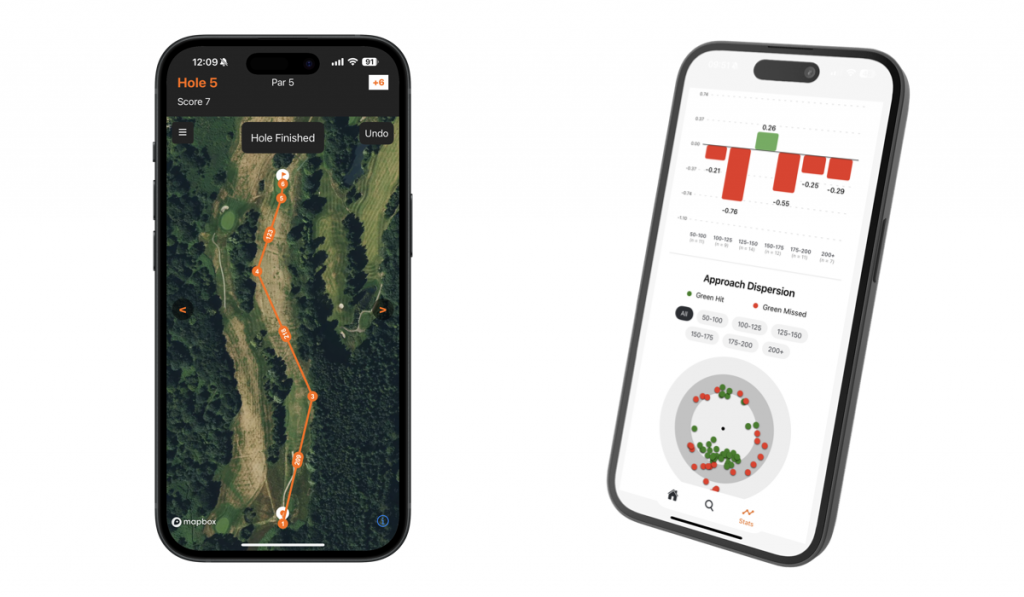
The cleanest way to do this is with strokes gained data. If you’re tracking strokes gained, your weakest area is simply the one with the biggest minus number. That’s where your practice time should go first. It doesn’t matter what benchmark you’re using — your own average, scratch, or a tour reference — you’re looking for the biggest gap and targeting it.
If strokes gained feels complicated, this article on strokes gained gives you a clear breakdown of how it works. We also have a free strokes gained calculator where you can enter any round and get your data immediately.
For golfers above roughly a 15 handicap, basic stats are perfectly fine to start with. Keep track of:
- Fairways hit (are you losing balls or missing significantly left or right?)
- Greens in regulation (are you giving yourself a realistic chance to two-putt?)
- Putts per round (are you above 36?)
- Up and down percentage (when you miss greens, how often do you get up and down?)
Once you have a couple of rounds of data, rank your areas from weakest to strongest. That ranking becomes your practice priority order.
A Sample Weekly Practice Routine
Using the tool above, you can build a custom practice plan using this approach. It asks you to rank the areas of your game (strongest to weakest) then you’ll see the tool allocates more time to your weaker areas.
For example:
Day 1 — Weakest area, 45 minutes 15 minutes technical work on your identified weakness (with reference to any coach feedback if applicable), 20 minutes blocked practice on that same area, 10 minutes skills game to apply it under pressure.
Day 2 — Second weakest area + maintenance, 45–60 minutes 20 minutes on your second priority area, 15 minutes on a strength (keeps confidence high), 10–15 minutes putting (non-negotiable every session).
Weekend — On the course, 9 or 18 holes Get on the course and score. This is where everything has to transfer.
That’s it. Simple, repeatable, and connected to your actual game. The specifics change based on your stats — but the structure stays the same.
Golf Practice Routines by Time Available
The one-hour golf practice routine
You can genuinely improve with one hour a week if it’s properly focused. Here’s how to use it.
Spend 30 minutes on your weakest area from your stats. Inside those 30 minutes, mix a little technical focus (what specifically are you working on?), some blocked practice reps, and at least one skills game so you’re getting measurable feedback rather than just hitting balls.
Use the remaining 30 minutes to cover the core shots you’ll face on the golf course every week — a few drives, mid irons, wedges, chip shots, and putts. You’re not trying to improve these areas, just keeping them ticking over.
One hour isn’t much, but used like this it’s enough to make progress. Scattered across the wrong things, it changes nothing.
The two to three hour golf practice routine
With two to three hours a week, you can work on two areas of your game and start to really develop one of your strengths into something special.
Split your time roughly as follows: 40% on your weakest area, 30% on your second weakest, 20% on a strength you want to make exceptional, and 10% on the last area (you want to cover all areas if you can).
For each area, follow the same structure: technical focus → blocked practice → skills game. The skills game is where your decision-making develops, so don’t skip it when you’re short of time.
If you can get nine holes on the course each week alongside this, do it. On-course scoring reps are irreplaceable.
The five+ hour weekly practice plan
This is where most committed golfers actually go wrong. More time doesn’t automatically mean more improvement — and without structure, five hours can entrench bad habits faster than one hour.
With five-plus hours available, you can genuinely work across all four areas of your game. But the temptation is to add more volume rather than more intensity, and that’s where the wheels come off.
For each area, maintain your basics first — grip, alignment, posture. These fundamentals drift, and they drift fastest when you’re hitting a lot of balls. A quick check at the start of each session stops you going off track. Just look at golf pros on the range, they all have alignment sticks down! (this is one of the things you should copy from the pros)
Then go deep on block practice. You need enough repetitions to create real skill development, not just the feeling of practice. Be specific about what you’re trying to achieve with each shot — lateral error, distance, ball flight, starting line. Vague practice produces vague improvement.
Make sure every area has a skills game to close the session. This is especially important when you’re putting in more hours, because without the pressure of keeping score, you lose the competitive edge that makes practice transfer to the course.
At five-plus hours, you should also be playing 18 holes as a minimum each week, ideally 27 or 36. When you play, mix in some competitive medal rounds with Break X Golf’s on-course skills games like the Par Challenge or In-Regulation Challenge. These keep it interesting and get you thinking differently about how to score — which is a different skill to hitting balls.
Golf Practice Routine by Handicap Level
Your time allocation matters, but so does what you focus on. Here’s how the priorities shift across handicap levels.
High handicap practice routine (20+)
At this level, the single biggest opportunity is avoiding the big numbers — double bogeys and worse. Scratch handicappers only make 2 more birdies a round compared to 25 handicappers, but 9 fewer double bogeys! Thats where the scoring difference comes from.
| Handicap | Birdies | Bogeys | Doubles + |
| 0 | 2.34 | 3.87 | 0.27 |
| 5 | 1.26 | 6.12 | 1.44 |
| 10 | 0.72 | 7.2 | 2.88 |
| 15 | 0.36 | 8.1 | 4.68 |
| 20 | 0.36 | 7.38 | 6.66 |
| 25 | 0.18 | 6.12 | 9.18 |
To eliminate doubles, focus on three things.
- Off the tee: solid contact that gets the ball in play. That’s the goal — not distance, not direction, make solid contact ans get the ball in play.
- On the fairway focus on advancing the ball, avoiding penalty situations, again focus on solid contact.
- Around the green: master one reliable chip shot that you can execute under pressure.
- Putting: master putts inside five feet — if you can reliably hole putts from inside five feet, it improves everything else about your putting too, because all aspect of putting rely on your ability to start the ball on your intended line (including pace putting)
Your practice sessions at this level should have a heavy emphasis on contact. Block practice with a focus on strike quality, not ball flight. The ball flight will become more consistent when you start striking shots well.
Mid handicap practice routine (10–20)
At this level, doubles are still the enemy (4.68 DB for 15 handicaps), but the game gets more nuanced. You’re now in a position to start thinking about where shots finish, not just whether you make contact.
This means picking smarter targets off the tee — accounting for your natural shape, playing to the wider part of the fairway, leaving yourself the easiest approach angle. It means taking enough club into greens and aiming for the biggest landing area rather than the pin. And it means really starting to build a picture of your shot dispersion — where do your shots actually end up compared to where you aimed?
- 20 Handicaps average 17% of greens in regulation
- 10 Handicaps average 37% of greens in regulation
If you have a significant weakness at this level — say putting is costing you five shots a round, this has to be the top of your priority in practice. Don’t let it sit as a known problem you’re not addressing.
The goal here is eliminating double bogeys while starting to build a short game (50–150 yards) that gives you more genuine birdie and par opportunities.
Low handicap practice routine (under 10)
Now you’re trying to get rid of bogeys as well as doubles. As you push towards scratch, you’re also looking to score better on par fives — these are your main birdie opportunities and you should be attacking them more intelligently. But still remember, scatch golfers only average 2.34 birdies a round, it still more about managing your mistakes.
The 50 to 150 yard zone becomes critical. Distance control with wedges and short irons is a real skill that takes dedicated practice, and most single-figure golfers who plateau are losing shots here without realising it. Get very good inside 30 to 40 yards around the greens as well — tour pros hole only 50% of putts from 8ft, so you need to get your chip and pitch shots inside this distance if you want to consistently get up and down.
Putting from five to ten feet is where most golfers gain or lose shots in strokes gained putting. So build a practice routine that puts you under real pressure from that distance repeatedly, so you can work on start line, green reading and pace control.
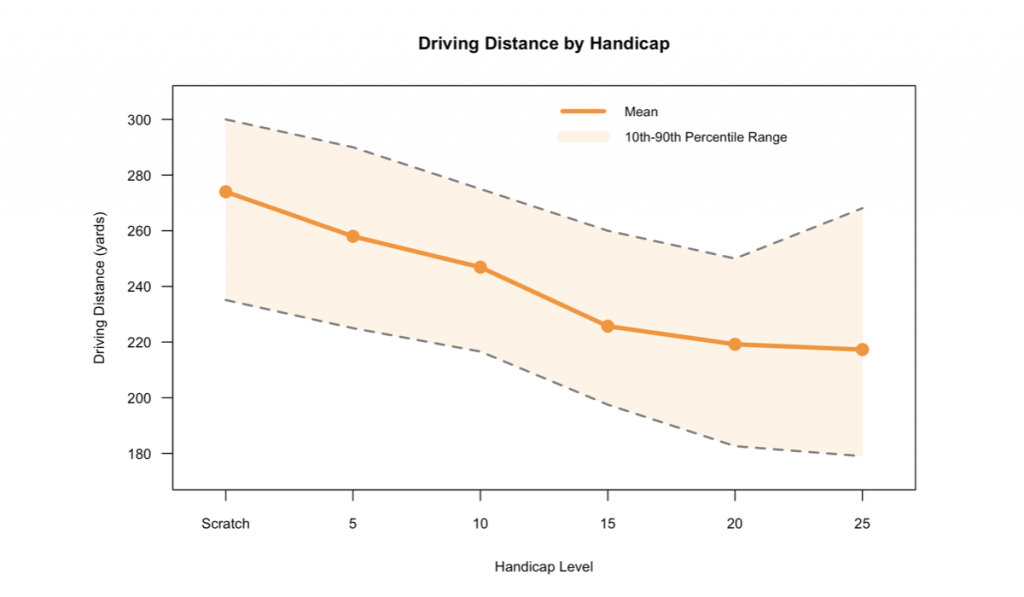
Some golfers will need more distance to reach the next level — the graph below shows you the average driving distance by handicap, but also the 10-90th percentiles. if your driving distance is below the orange shaded line, it will be very difficult (not impossible) to reach your desired handicap.
How to Structure Each Practice Session
Whatever your handicap level, each session should follow the same four-part structure (or at least cover these across a week).
Warm-up
Do some dynamic movement first — a few mini squats, lunges with rotation, anything to get the body moving. I also like swinging the club with my left hand only, then my right, then both together. It builds stability and strength in some areas that are tricky to target in the gym.
Your first five to ten balls aren’t practice balls — they’re warm-up balls. Hit them with the sole intention of making contact and getting looser. It doesn’t matter where they go. I see so many golfers at the range get angry with these shots…
Blocked practice
This is where you develop skill with many reps. Pick a target, get specific about what you’re working on, and track your outcomes. Not just lateral error (left or right of target) but distance, ball flight, starting line, and the quality of strike. Get really dialled into where each shot finishes and how each swing feels – don’t just go through the motions of hitting balls.
You need enough volume here to actually cause a skill change. That number can be as little as 10 for a beginner but moves into the thousands for an elite player. I would recommend that most golfers stick to practice sessions of 50 balls or fewer in one range session. After this, I think golfers get diminishing returns, make more bad swings and get tired.
Skills games
This is the part most golfers skip, and it’s the most important for transferring your practice to the golf course. Pick a skills game for your priority area and keep score. Set yourself a target score you have to reach before you leave. That pressure is exactly what you need — it replicates the decision-making environment of the golf course in a way that blocked practice can’t.
Break X Golf has over 130 skills games for every area of the game. But we give away free skills games for each area of your game for everyone who joins our golf performance newsletter.
How Long Should You Stick to a Routine?
Four to six practice sessions is a good timeline. Most golfers change their plan too quickly after one or two sessions where they don’t feel like they’re improving (if they have one in the first place).
Think of it like the gym. You don’t go once and check if you’re stronger. You commit to the programme and review after a proper block. In golf, you need enough repetitions across enough sessions to cause a real skill change, not just a feeling of familiarity.
Four to six practice session is also enough time to re-check your playing stats and see whether the area you’ve been working on has actually moved. If it has, great — adjust your priorities. If it hasn’t, dig into why before you switch to something new.
If you want your practice plan built automatically from your playing stats — without having to work through the process above yourself — that’s exactly what Break X Golf does. Enter a round, it ranks your weaknesses, builds you a prioritised practice plan, and updates it every time you play.
Summary
I hope this article has given you a great foundation and simple approach to building your own practice routine, which will actually lower your scores. If you want an automated way to build personalised practice routines, check out the Break X Golf app with a free 7-day trial.
Happy golfing – Will @ Break X Golf